An AI visibility strategy is a plan for showing up when people ask ChatGPT, Gemini, Perplexity, Google AI Overviews, or Copilot a question your business could answer. It is different from traditional SEO because the goal isn’t just ranking a page; it’s being cited, mentioned, or recommended inside an AI-generated answer. As AI visibility changes online search, more buying journeys now start and end inside a chat window, which means brands need a deliberate approach rather than hoping existing SEO carries over.
Building that strategy comes down to seven steps: setting a baseline, making your site accessible to AI crawlers, clarifying your entity, creating answer-first content, earning third-party authority, measuring citations, and avoiding the common pitfalls that stall progress.
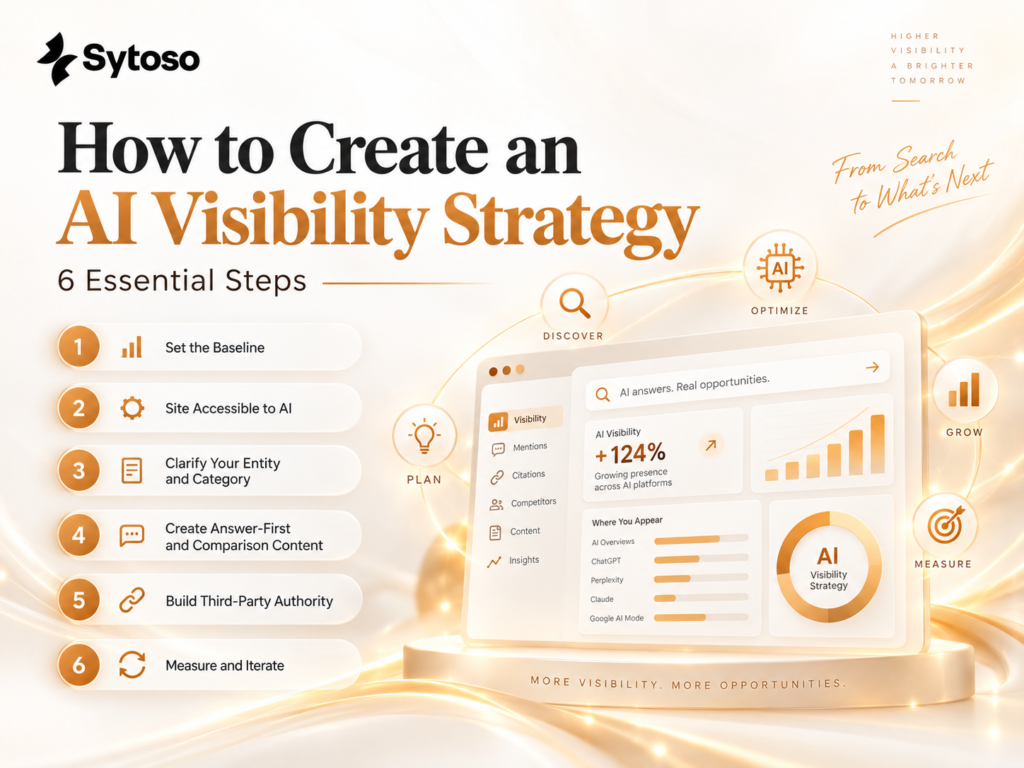
How to Create an AI Visibility Strategy
Follow these steps to build a clear and measurable AI visibility strategy for your brand.
Step 1: Set the Baseline
Before changing anything, find out where you currently stand. Pick 20–30 prompts your buyers would realistically type, things like “best [category] for [use case]” or “[competitor] alternatives”, and run them across ChatGPT, Gemini, Perplexity, and Google AI Mode. Note whether your brand appears, whether competitors appear instead, and what sources those platforms are pulling from.
This baseline becomes your priority list. If you want a structured way to do this rather than testing prompts one by one, how to conduct an AI visibility audit walks through a repeatable process, including which queries to prioritise first and how to track competitive citation gaps.
Step 2: Make Your Site Accessible to AI
AI models can only cite what they can crawl and understand. That starts with technical basics: confirm AI crawlers (GPTBot, ClaudeBot, PerplexityBot, Google-Extended, and others) aren’t blocked in robots.txt, check that your key pages render without relying on heavy JavaScript, and make sure structured data- Organization, Article, Product, and FAQ schema- accurately describes your content.
This is also where an llms.txt file, sitemap hygiene, and clean internal linking help, since they give AI systems a clearer map of what your site covers and how pages relate to each other. For a full technical walkthrough, how to optimize your website for AI search engines covers indexability, page speed, and rendering issues in more depth.
Step 3: Clarify Your Entity and Category
AI models rely heavily on entity recognition, understanding what your brand is, what category it belongs to, and how it relates to other known entities. Inconsistent descriptions across your website, Wikipedia, G2, industry directories, and social profiles make this harder. Use consistent positioning language everywhere your brand appears, avoid vague self-descriptions, and make sure your category and core offering are stated plainly, not implied.
This entity clarity is also what determines whether a model recommends you over a competitor. How do AI search engines decide which brands to recommend breaks down the signals models weigh most, including third-party validation and consistent brand description.
Step 4: Create Answer-First and Comparison Content
AI systems favour content that answers a question directly, in the first few sentences, rather than content built around keyword density. Structure pages with clear H2/H3 headings, put the direct answer near the top, then support it with data, examples, or a table. Comparison and alternatives content, “X vs Y” or “best alternatives to X”, performs particularly well, since these are exactly the prompts buyers type into AI tools.
Original statistics, expert quotes, and genuinely useful tables also increase extractability, since models tend to cite content that says something a dozen other pages haven’t already said.
Step 5: Build Third-Party Authority
Unlike traditional SEO, AI visibility depends heavily on what other sites say about you, not just what your own site says. Digital PR, guest content, analyst mentions, reviews, and even unlinked brand mentions all feed into how confidently a model recommends you. This is often the slowest part of an AI visibility strategy, but it’s also the hardest for competitors to copy quickly.
If your brand specifically wants stronger presence inside ChatGPT, improving brand visibility in ChatGPT looks at how ChatGPT sources answers and what influences whether it surfaces a brand by name.
Step 6: Measure and Iterate
Track citation share (how often you appear across your priority prompts), recommendation share (how often you’re the one recommended, not just mentioned), and AI referral traffic in GA4. Review this monthly rather than as a one-time project; AI models update frequently, and a strategy that isn’t reviewed goes stale fast.
To keep the process consistent across your team, working from a fixed list of tasks helps more than relying on memory. The AI visibility checklist lays out exactly what to check and how often, from crawler access to entity consistency to content refreshes.
Common Mistakes to Avoid
A few mistakes show up repeatedly:
- Skipping the foundation. Publishing new content before fixing crawler access or entity inconsistencies wastes the content.
- Chasing one platform. Optimising only for ChatGPT while ignoring Gemini or Perplexity leaves visibility gaps.
- Treating it as a one-time project. AI visibility needs the same ongoing attention as SEO, not a single audit.
- Assuming access guarantees a citation. Being crawlable is necessary, but not sufficient; relevance, authority, and clarity still decide whether you’re the one referenced.
Final Thoughts
An AI visibility strategy isn’t a single tactic; it’s the combination of technical access, clear entity signals, answer-first content, third-party authority, and consistent measurement. Sydney and global brands that treat this as an ongoing discipline, rather than a one-off fix, are the ones showing up when AI tools answer their buyers’ questions.
If building and managing this in-house isn’t realistic right now, how to choose an AI visibility agency covers what to look for before handing the work off to someone else.