AI visibility means your brand actually shows up when someone asks ChatGPT, Perplexity, or Google AI Overviews a question related to your business. Unlike traditional rankings, AI search engines summarize, cite, and recommend sources based on clarity, structure, and trust rather than backlinks alone. Getting this right takes deliberate AI visibility optimization across your content, structured data, and off-site presence not a single quick fix. This checklist breaks the process into nine practical steps you can start acting on this week.
Jump to Section
- Why AI Search Behaves Differently
- AI Visibility Checklist: 9 Steps to Improve AI Search
- What This Doesn’t Guarantee
- FAQs about AI Visibility Checklist
Why AI Search Behaves Differently
Google AI Overviews, ChatGPT, and Perplexity don’t crawl and rank pages the way a traditional search engine does; they read, interpret, and pull the clearest answer from whichever source explains it best. That shift is changing online search in a fundamental way: pages written to satisfy a ranking algorithm often don’t get picked up by an AI model, while pages written to answer a question directly get quoted and cited. The checklist below is built around that difference.
AI Visibility Checklist: 9 Steps to Improve AI Search
A step-by-step checklist to help your brand get found, cited, and recommended by ChatGPT, Perplexity, and Google AI Overviews.
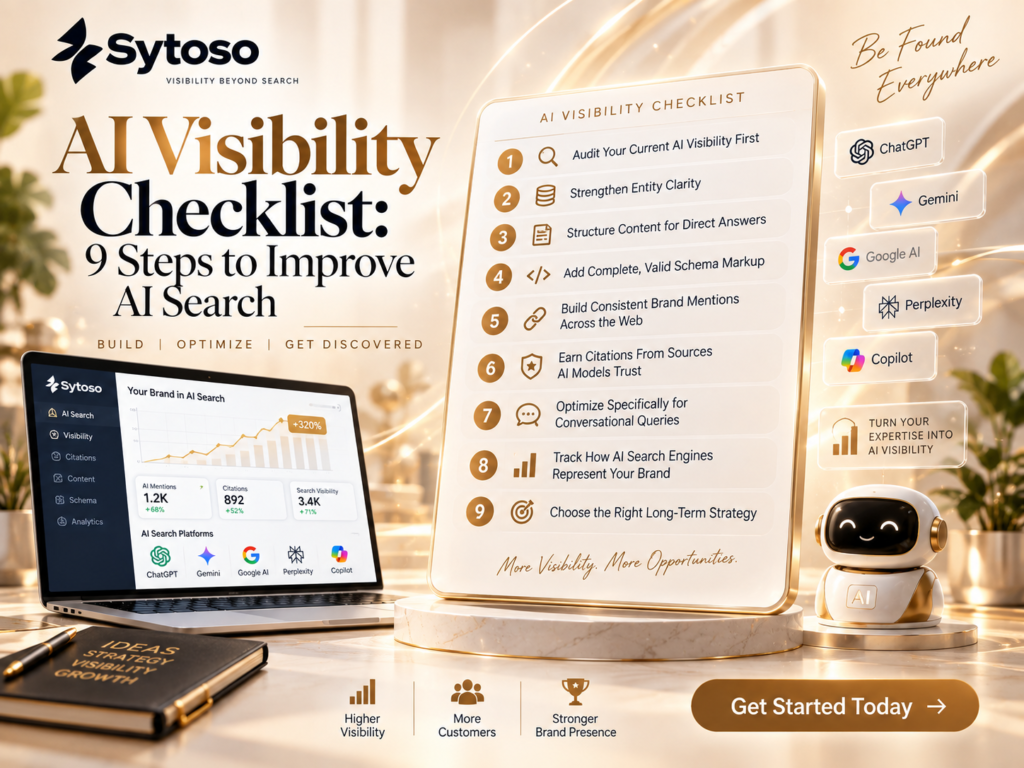
1. Audit Your Current AI Visibility First
Before changing anything, find out where you already stand. Ask ChatGPT, Perplexity, and Google AI Overviews your top service-related questions and note whether your brand appears, how it’s described, and which competitors show up instead. A proper visibility audit process also checks your schema, entity data, and citation footprint, not just whether you get mentioned once.
2. Strengthen Entity Clarity
AI models need to know exactly who you are, what you do, and where you operate before they’ll recommend you. This means consistent business name, service descriptions, and location details across your website, Google Business Profile, and directories. Vague “About Us” pages and mismatched service names are one of the most common reasons a genuinely good business stays invisible to AI search.
3. Structure Content for Direct Answers
Write the answer first, then explain it. AI models pull short, clear answer blocks (40–80 words) more reliably than long introductory paragraphs. Use question-style headings, put the direct answer immediately underneath, and follow with context, steps, and proof. This is also how you optimize for AI search without rewriting your entire site; you’re restructuring existing content, not starting from scratch.
4. Add Complete, Valid Schema Markup
Schema is how you tell an AI model what a page actually is, in a format it can read with certainty instead of guessing. At minimum, that means Organization, LocalBusiness, Service, FAQ, and Review schema where relevant. Incomplete or invalid schema doesn’t just fail to help; it can actively confuse how a model categorizes your business.
5. Build Consistent Brand Mentions Across the Web
AI models weigh how often and how consistently your brand is mentioned across the web: review platforms, directories, industry sites, social profiles. This is part of how AI search engines decide which brands to recommend: repeated, consistent mentions build the kind of confidence a single well-optimized page can’t create on its own.
6. Earn Citations From Sources AI Models Trust
Not all mentions carry equal weight. A mention on a recognized industry publication or a trusted local directory does more for your AI visibility than ten low-quality directory listings. Focus link-building and PR efforts on sources that are themselves frequently cited by AI models, rather than volume for its own sake.
7. Optimize Specifically for Conversational Queries
People ask AI tools full questions: “who’s the best dentist near me that takes walk-ins,” not fragmented keywords. Map your content to these natural-language questions, including comparison and “best X for Y” queries. Improving your visibility in ChatGPT specifically often comes down to whether your content actually answers the way people phrase things, not just whether it ranks for a keyword.
8. Track How AI Search Engines Represent Your Brand
Monitoring shouldn’t stop after the first fix. Set a recurring schedule, weekly or biweekly, to check how different AI tools describe your business, which competitors get mentioned alongside you, and whether any outdated or inaccurate information is being repeated. AI visibility shifts as models update, so this isn’t a one-time task.
9. Choose the Right Long-Term Strategy
Some businesses can manage steps 1–8 in-house with consistent effort. Others don’t have the time or in-house expertise to track model updates, schema changes, and citation opportunities alongside everything else. If you’re weighing that trade-off, it’s worth understanding choosing an AI visibility agency versus handling it internally before committing resources either way.
What This Doesn’t Guarantee
No agency or checklist can guarantee a specific AI model will mention your brand for a specific query; the models change frequently, and citation behavior varies across ChatGPT, Perplexity, and Google AI Overviews. What consistent work on these nine steps does is measurably improve the probability that your brand is understood, trusted, and considered when a relevant question comes up. This is exactly the kind of ongoing, cross-platform work Sytoso helps businesses stay on top of, since tracking model updates and citation opportunities across every AI tool at once isn’t realistic to do manually, week after week.
FAQs about AI Visibility Checklist
Is AI visibility the same as SEO?
No. SEO focuses on ranking pages in traditional search results. AI visibility focuses on whether AI models understand, trust, and cite your brand when generating an answer. The two overlap; clean structure and authority help both, but they aren’t the same discipline.
How long does it take to see results?
Most businesses see early signals (correct mentions, accurate descriptions) within a few weeks of fixing entity and schema issues. Consistent citations and recommendations across multiple AI tools typically take longer, since they depend on model training and update cycles.
Do I need to rewrite my whole website?
Usually not. Most sites need restructuring of existing pages, clearer headings, direct answers, and better schema rather than a full rewrite. A visibility audit will show which pages need the most work first.
Which AI tools should I check?
At minimum, check ChatGPT, Google AI Overviews, and Perplexity, since they cover the largest share of AI-driven queries. Depending on your industry, it’s also worth checking niche or region-specific AI search tools your customers might use.