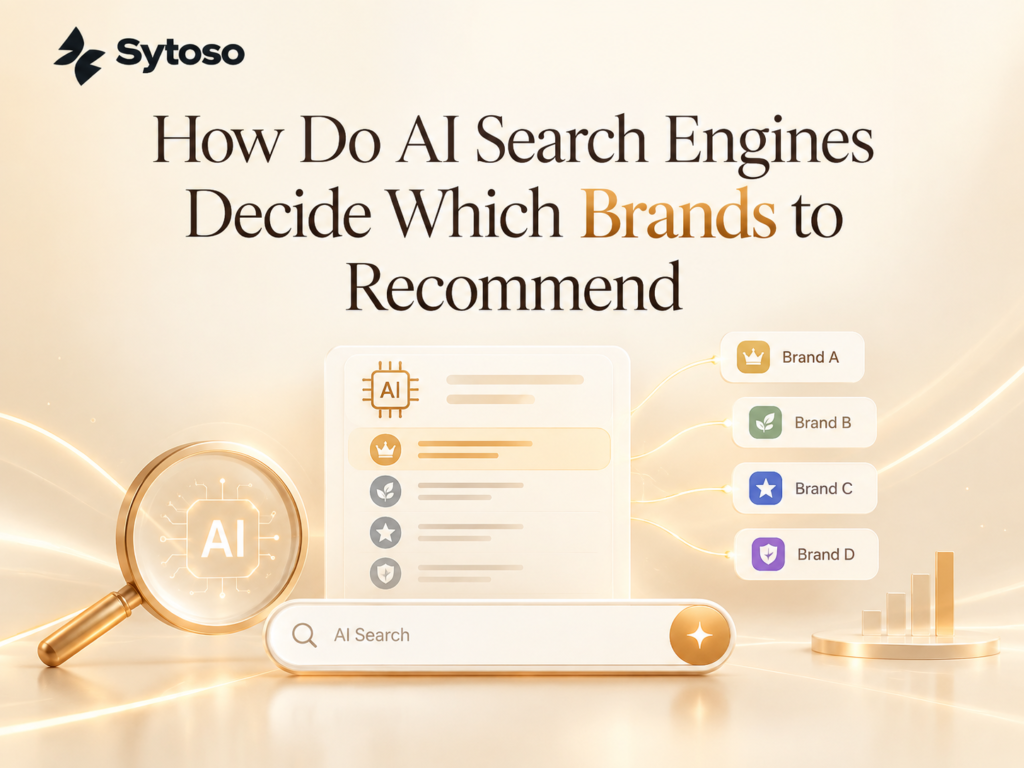
When users ask AI search engines to recommend a product, service, company, or local business, the platform does not simply choose the brand with the highest traditional search ranking. AI search engines evaluate multiple signals to understand which brands are relevant, credible, authoritative, and useful for a particular query.
AI search engines decide which brands to recommend by analysing factors such as relevance, content quality, brand authority, online mentions, reviews, citations, website information, entity recognition, and user intent. The stronger and more consistent these signals are, the more likely a brand is to be considered for relevant AI-generated answers.
Understanding these factors can help businesses improve their visibility across AI search experiences and increase the likelihood of being mentioned when potential customers ask AI platforms for recommendations.
Jump to Section
- What Are AI Search Engines?
- How AI Search Engines Understand Brands
- Factors That Influence AI Brand Recommendations
- How AI Search Engines Compare Competing Brands
- Why Some Brands Get Recommended More Often Than Others
- How to Make Your Brand More Likely to Be Recommended by AI Search Engines
- Common Factors That Can Reduce Brand Recommendations in AI Search
- Conclusion: Build the Signals AI Search Engines Trust
- FAQs About AI Brand Recommendations
What Are AI Search Engines?
AI search engines are search and answer platforms that use artificial intelligence to understand questions and generate direct responses. Instead of simply presenting a list of web pages, they can interpret the user’s intent, combine information from different sources, and provide a conversational answer.
Users may ask questions such as:
- Which SEO agency should I choose in Sydney?
- What are the best accounting firms for small businesses?
- Which project management software is best for a growing company?
- What digital marketing agencies offer Google Ads services?
For these types of queries, AI systems need to determine which brands are relevant and trustworthy enough to include in their answers.
How AI Search Engines Understand Brands
AI systems do not look at a brand from only one webpage. They can build an understanding of a business from information available across its website and wider online presence.
Several signals can contribute to this understanding.
Understanding Brand Relevance and Context
First, an AI system needs to determine whether a brand is relevant to the user’s question. A business that clearly specialises in a particular service or category is more likely to be considered when the query matches that expertise.
For example, if a company consistently publishes detailed information about SEO, Google Ads, and digital marketing, AI systems have more context for understanding what that company does.
Evaluating Brand Authority and Trust
AI search engines also need signals that indicate whether a brand is credible. Strong content, reputable mentions, positive reviews, expert references, and a consistent online presence can all contribute to perceived authority.
Matching Brands With User Intent
The same user may ask different questions with different intentions. Someone looking for the “best SEO agency” has a different intent from someone searching for “cheap SEO services.”
AI systems therefore need to match potential recommendations with the specific context and intent behind the query.
Factors That Influence AI Brand Recommendations
These are the key factors AI search engines consider when deciding which brands to recommend.
1. Relevance to the User’s Query
Relevance is one of the most important factors in AI-generated recommendations.
A brand is more likely to be considered when its products, services, expertise, location, or content closely match what the user is asking about.
For example, a Sydney-based business offering Google Ads management is more relevant to a query about Google Ads agencies in Sydney than a general marketing company with no clear Google Ads offering.
Businesses can strengthen relevance by creating dedicated service pages, detailed topic content, location-specific information, and clear descriptions of their products or services.
2. Brand Authority and Expertise
AI search engines need to distinguish between businesses that simply mention a topic and those that demonstrate genuine expertise.
A strong authority profile can be supported by:
- Detailed educational content
- Expert insights
- Industry-specific resources
- Original research
- Case studies
- Reputable online mentions
- Consistent expertise across related topics
A brand that consistently demonstrates expertise around a subject gives AI systems more information to associate that brand with the topic.
3. Content Quality and Topical Coverage
Content helps AI systems understand what a business knows and what it offers.
However, simply publishing a large number of articles is not enough. Content should answer real questions and provide useful, accurate information.
For example, an SEO agency could cover:
- Technical SEO
- Local SEO
- Keyword research
- Link building
- SEO audits
- Google Search visibility
- AI search optimisation
- Content optimisation
Comprehensive topical coverage gives AI systems more context about the brand’s expertise.
4. Online Brand Mentions and Reputation
AI systems can encounter brand information outside a company’s own website.
Mentions on relevant websites, industry publications, directories, news websites, professional platforms, and other authoritative sources can help establish a broader online presence.
This is important because a brand’s reputation is not created entirely on its own website.
The more consistently a business is associated with a specific service, industry, or area of expertise across trusted sources, the stronger its overall digital footprint can become.
5. Third-Party Sources and Citations
Third-party references can provide additional context about a brand.
For example, a company may be mentioned by:
- Industry publications
- Business directories
- Review platforms
- Professional organisations
- News websites
- Relevant blogs
- Local business resources
These references can help reinforce associations between the brand and its products, services, expertise, or location.
Quality matters more than simply accumulating large numbers of mentions. Relevant and trustworthy sources are generally more valuable than unrelated websites.
6. Reviews and Customer Sentiment
Reviews can provide important information about how customers perceive a business.
For local businesses especially, customer feedback can help establish reputation and credibility.
AI search visibility should not be treated as a simple review-count competition. However, consistent positive feedback across relevant platforms can contribute to a stronger overall online reputation.
Businesses should therefore encourage genuine customer feedback and respond professionally to reviews.
7. Website Structure and Accessible Information
AI systems need to understand the information presented on a website.
A clear website structure makes this easier by organising important information logically.
Businesses should clearly communicate:
- Who they are
- What they offer
- Who they serve
- Where they operate
- What makes them different
- How customers can contact them
Service pages should clearly explain the service rather than relying on vague marketing language.
Clear headings, descriptive page titles, internal links, structured information, and well-organised content can also make important information easier to understand.
8. Consistency of Brand Information
Inconsistent information can make it harder to understand a brand clearly.
For example, a business might use different names, descriptions, addresses, phone numbers, or service information across different platforms.
Businesses should aim to maintain consistent information across:
- Their website
- Business profiles
- Social platforms
- Industry directories
- Review platforms
- Professional profiles
Consistency helps create a clearer digital identity for the business.
9. Entity Recognition and Brand Associations
AI systems need to understand that different references across the web may represent the same business.
This is where entity recognition becomes important.
A brand can be associated with particular services, products, people, locations, industries, and topics. For example:
Brand → Digital Marketing Agency → SEO → Google Ads → Sydney
The stronger and more consistent these relationships are across reliable sources, the easier it can be for AI systems to understand the brand’s identity and areas of expertise.
10. User Intent and Context
AI search engines do not only analyse the words in a query. They also need to understand what the user actually wants.
Consider these searches:
“Best SEO agency in Sydney”
The user is looking for recommendations.
“How much does SEO cost in Sydney?”
The user is looking for pricing information.
“SEO agency vs freelancer”
The user is comparing options.
A brand that provides useful information for different stages of the customer journey can create more opportunities to become relevant to different AI queries.
How AI Search Engines Compare Competing Brands
When several brands could answer a user’s query, AI systems need to determine which options are most relevant.
A simplified way to think about the process is:
User Query → Intent Understanding → Brand Discovery → Relevance → Authority → Trust Signals → Context Matching → AI Recommendation
This does not mean every AI platform uses one universal scoring system. Different systems can use different models, data sources, retrieval methods, and ranking processes.
For businesses, the practical lesson is simple: do not optimise for one signal alone. Build a strong and consistent digital presence across multiple areas.
Why Some Brands Get Recommended More Often Than Others
Two businesses can offer similar services but receive very different levels of AI visibility.
This can happen because one brand may have:
- More comprehensive content
- Stronger topical authority
- More relevant online mentions
- Better-established brand associations
- Clearer service information
- Stronger customer reputation
- More consistent business information
- A stronger overall digital presence
This is why AI visibility should be viewed as a broader digital authority problem rather than simply another version of traditional keyword ranking.
How to Make Your Brand More Likely to Be Recommended by AI Search Engines
There is no guaranteed formula for getting recommended by an AI search engine. However, businesses can strengthen the signals that help AI systems understand and evaluate their brand.
Create Helpful, Authoritative Content
Answer the questions your customers actually ask. Focus on useful explanations, practical guidance, comparisons, examples, and industry insights rather than producing content solely to target keywords.
Build Strong Online Brand Signals
Develop a consistent presence across relevant websites, business directories, professional platforms, publications, and other trusted sources.
Strengthen Your Digital Reputation
Encourage genuine reviews, showcase customer experiences, publish case studies, and demonstrate expertise through useful content.
Keep Business Information Accurate and Consistent
Make sure your business name, services, location, contact information, and other important details are accurate across relevant platforms.
Improve Your AI Search Visibility
Regularly test how AI platforms respond to queries related to your business, services, products, and competitors. This can reveal where your brand is being mentioned, where competitors are appearing, and which topics require stronger coverage.
Also Read >> How to Improve AI Visibility
Common Factors That Can Reduce Brand Recommendations in AI Search
Several weaknesses can make it harder for AI systems to understand or confidently recommend a brand.
Common issues include:
- Limited information about products or services
- Thin or generic content
- Inconsistent business information
- Few relevant third-party mentions
- Weak topical coverage
- Poor website structure
- Lack of clear expertise
- Outdated information
- Weak online reputation
- No monitoring of AI search visibility
Fixing these weaknesses can make the brand’s overall digital presence clearer and more useful.
Conclusion: Build the Signals AI Search Engines Trust
AI search recommendations are influenced by more than keywords or traditional search rankings. AI systems need enough reliable information to understand what a brand does, who it serves, how relevant it is, and whether it can be trusted for a particular query.
For businesses, the goal should be to build a strong and consistent digital presence across content, authority, reputation, website information, third-party mentions, and brand associations.
The brands most prepared for AI search are not necessarily those that simply optimise for one platform. They are the businesses that consistently demonstrate expertise and credibility across the wider digital ecosystem.
FAQs About AI Brand Recommendations
How does AI decide which brand to recommend?
AI search engines can consider factors such as query relevance, content quality, brand authority, online mentions, reputation, available information, and user intent when generating recommendations.
What makes a brand trustworthy to AI search engines?
Clear information, strong expertise, quality content, relevant third-party references, consistent business details, and a credible online reputation can all contribute to stronger trust signals.
Do backlinks influence AI brand recommendations?
Backlinks can contribute to a website’s overall authority and discoverability, but AI recommendations are not determined by backlinks alone. A broader combination of content, relevance, authority, and brand signals matters.
Do reviews affect AI search visibility?
Reviews can contribute to a brand’s online reputation, particularly for businesses where customer experience is important. Genuine and consistent customer feedback can strengthen overall trust signals.
Can SEO help a brand get recommended by AI?
Yes. Good SEO practices can help AI systems discover and understand a website. However, AI search visibility extends beyond traditional rankings and also involves brand authority, entity understanding, reputation, and third-party information.
How can a new brand appear in AI search results?
A new brand can build visibility by creating useful content, developing clear service information, establishing relevant online mentions, maintaining consistent business information, and demonstrating expertise within its niche.
Is AI search visibility the same as Google rankings?
No. Traditional search rankings and AI visibility overlap in some areas but are not identical. AI search focuses on understanding queries and generating answers, while traditional search primarily ranks webpages for users to explore.