AI may mention your brand because it recognises your business, but recommend a competitor because that competitor appears more relevant, credible, clearly defined, and supported by stronger third-party evidence.
AI search tools do not recommend businesses simply because they have a website or rank in traditional search. They assess whether a brand best fits the user’s exact question and whether reliable information supports that choice. Weak entity signals, limited reviews, generic content, inconsistent business details, or little evidence of expertise can cause AI to include your brand in a list but select a competitor as the preferred option.
The good news is you can fix this gap. By improving topical authority, brand consistency, trusted mentions, and answer-focused content, you can increase the likelihood of becoming the brand AI recommends.
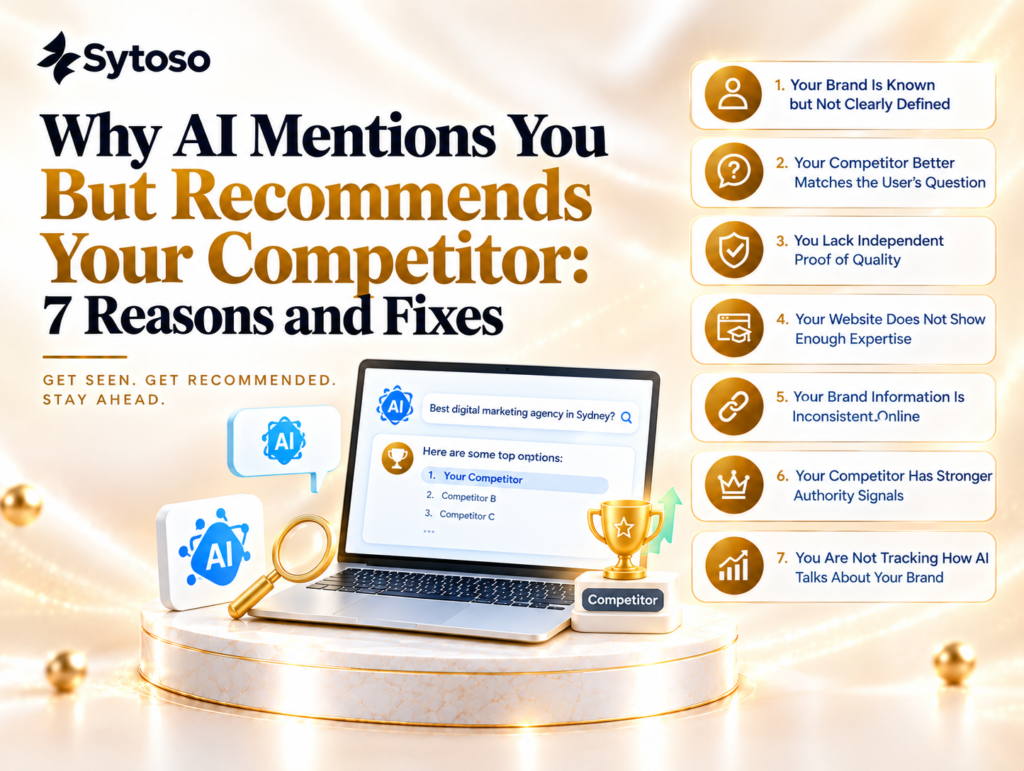
Why AI Mentions You But Recommends Your Competitor: 7 Reasons and Fixes
Here are seven reasons this may be happening and how to address each one.
- Your Brand Is Known but Not Clearly Defined
- Your Competitor Better Matches the User’s Question
- You Lack Independent Proof of Quality
- Your Website Does Not Show Enough Expertise
- Your Brand Information Is Inconsistent Online
- Your Competitor Has Stronger Authority Signals
- You Are Not Tracking How AI Talks About Your Brand
1. Your Brand Is Known but Not Clearly Defined
AI needs to understand exactly what your company does, who it serves, where it operates, and what makes it different. If your website, business profiles, and third-party mentions use vague or inconsistent descriptions, AI may recognise your brand without understanding when it should recommend you.
Your competitor may have clearer entity signals, including a consistent service description, business category, location details, leadership information, and supporting content across trusted websites.
Fix: Create a clear, consistent brand description and use it across your website, Google Business Profile, social profiles, directories, and industry listings. Clearly define your services, target customers, locations, and areas of expertise.
2. Your Competitor Better Matches the User’s Question
AI recommendations are highly dependent on context. A user may ask for “the best personal injury law firm for a car accident claim,” “a family lawyer for a child custody case,” “a trusted healthcare provider for diabetes management,” or “a local clinic that offers same-day urgent care.”
Even if your business is relevant, AI may recommend a competitor whose content directly addresses that specific service, condition, legal matter, location, or patient and client need. Generic service pages may be enough to earn a mention, but not enough to win a recommendation.
Fix: Build detailed pages around your core services, client needs, locations, and common questions. For example, a law firm should cover specific case types, while a healthcare provider should explain conditions treated, services available, and patient pathways.
3. You Lack Independent Proof of Quality
AI platforms place more confidence in brands that are supported by credible third-party sources. These can include authentic customer reviews, editorial mentions, expert roundups, case studies, industry directories, professional associations, and business listings.
If your website claims you are experienced or results-driven but independent sources do not support those claims, AI has less evidence to rely on. A competitor with strong reviews, credible client feedback, recognised partnerships, and trusted online mentions has a stronger recommendation profile.
Fix: Earn genuine reviews from customers, maintain accurate directory profiles, publish real case studies, and seek coverage from relevant, reputable industry websites. Never rely on claims that cannot be verified elsewhere.
4. Your Website Does Not Show Enough Expertise
A short service page may explain what you offer, but it rarely demonstrates deep expertise. AI systems are more likely to recommend brands that publish useful, accurate, and specific information supported by real experience.
For example, an AI SEO agency that only states it offers “ChatGPT optimisation” may be mentioned. An agency that explains entity optimisation, AI citation building, prompt research, structured data, content strategy, and measurement provides clearer evidence of expertise.
Fix: Publish in-depth service pages, practical guides, original research, expert insights, FAQs, and case studies. Make sure the content is written or reviewed by people with relevant experience and credentials.
5. Your Brand Information Is Inconsistent Online
Conflicting business details make it harder for AI to trust and connect information about your brand. Differences in your company name, address, website URL, phone number, service list, or descriptions across online sources can weaken your digital entity.
Fix: Audit your key business profiles and directories. Keep your core business details accurate and aligned across every important platform. You do not need identical wording everywhere, but the facts about your brand should always match.
Also read: How to Conduct an AI Visibility Audit
6. Your Competitor Has Stronger Authority Signals
Authority is more than backlinks. It includes the quality of the websites that cite your brand, the depth of your topical content, your reputation in the industry, and whether experts, customers, or publishers view you as a reliable choice.
Your competitor may appear in respected publications, contribute expert commentary, earn relevant links, or be repeatedly referenced in niche conversations. These signals make the competitor easier for AI to recommend with confidence.
Fix: Create resources worth referencing, contribute expert opinions to relevant publications, earn high-quality mentions, and build authority in the topics your customers care about most.
7. You Are Not Tracking How AI Talks About Your Brand
Traditional rankings and website traffic do not show the full picture. You need to know which prompts mention your brand, which competitors AI recommends, the sources included in those answers, and where your brand is missing.
Fix: Monitor AI visibility regularly across ChatGPT, Google AI Overviews, Perplexity, and Gemini. Use those insights to identify content gaps, weak citations, missing entity signals, and competitor advantages, then turn them into a focused improvement plan.
Final Thoughts: From Mentioned to Recommended
Being mentioned by AI means your brand exists in its knowledge base. Being recommended means AI trusts you as the best answer.
That trust is not built by having more content or a better-looking website. It is built on clarity, consistency, and credible proof. AI needs to clearly understand who you help, what you do best, and why you are a safer choice than the competitor next to you.
The brands that win in AI search are not necessarily the biggest. They are the most clearly defined, the most specifically helpful, and the most consistently verified across the web.
If AI is mentioning you but choosing someone else, treat it as a diagnostic signal, not a failure. Fix your entity signals, align your brand information, create content that answers real client questions, and earn the third-party mentions that prove your expertise.
Do that consistently, and you will stop being just another name in the list; you will become the brand AI recommends first.
Want to check how AI sees your brand? Get a free AI visibility audit.