To get featured in Google AI Overviews, you need to already rank in the top 10, answer the query directly in the first 50-70 words, and make that answer easy for AI to lift with clean structure, E-E-A-T signals, and schema markup. Google says there’s no special trick, but data proves the pages it cites are fast, factual, and structured.
Getting into AI Overviews is not luck anymore; it’s strategy. If you want to win in zero-click search, mastering AI Overview optimization is now as important as classic SEO. Here’s the reality: AI Overviews appear on over 20% of all Google searches, and they are changing clicks fast.
A Seer Interactive study tracking 3,119 keywords found organic CTR for queries with AI Overviews dropped 61%, from 1.76% in June 2024 to just 0.61% by September 2025. Ahrefs analyzed 300,000 keywords and found the top-ranking page loses 34.5% of clicks when an AI Overview shows up, and by December 2025 that loss grew to 58%. The upside? Brands cited inside the overview get 35% more organic clicks and 91% more paid clicks than brands that aren’t cited.
So you don’t want to fight AI Overviews. You want to be featured in them.
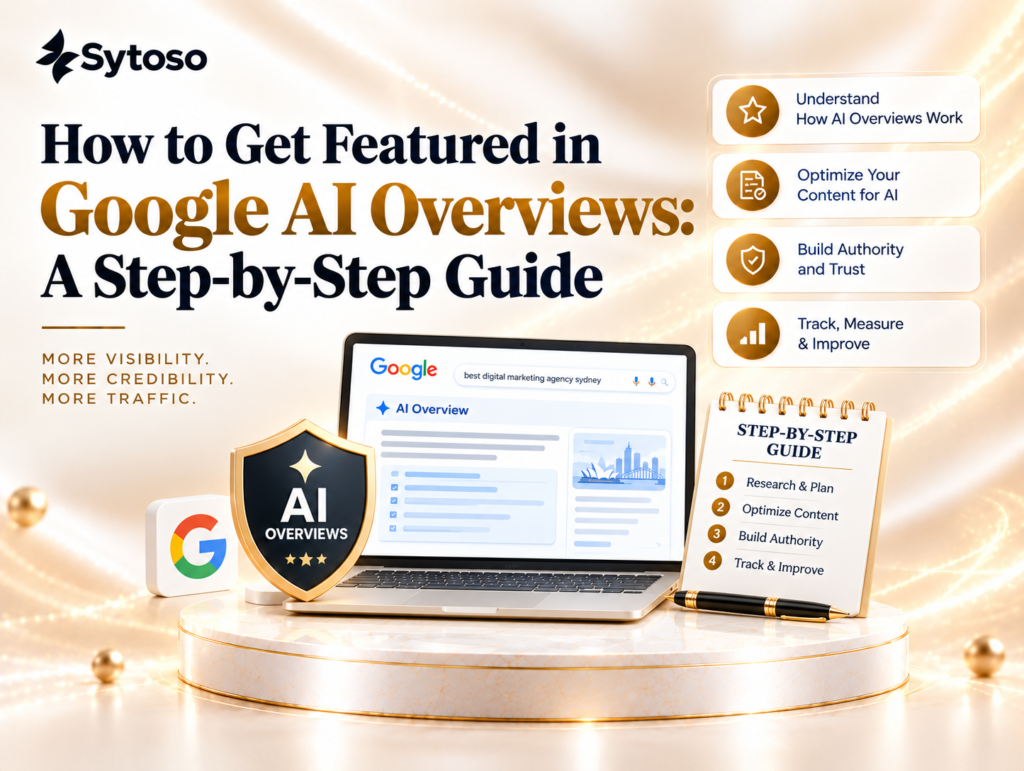
How to Get Featured in Google AI Overviews: A Step-by-Step Guide
Follow these steps to get your content featured in Google AI Overviews.
- Step 1: Win the Underlying Ranking First
- Step 2: Lead With a Liftable Answer
- Step 3: Structure for Machine Reading
- Step 4: Show E-E-A-T Like You Mean It
- Step 5: Add Schema That Helps AI Confirm
- Step 6: Optimize for Zero-Click AND the Click
Step 1: Win the Underlying Ranking First
Google’s own documentation says there are no extra technical requirements for AI Overviews, but the data is clear: Overviews pull from pages that already rank.
Authoritas found pages in Position 1 have a 53% chance of being included in AI Overviews, while pages in Position 10 only have a 36.9% chance.
That means your foundation is still classic SEO:
- Target informational queries (99.2% of AI Overviews are informational)
- Cover search intent fully, not just keywords
- Build topical authority with supporting cluster content
- Get real backlinks and brand mentions; Google trusts entities, not just text
If you’re not on page one, you’re almost invisible to the AI.
Step 2: Lead With a Liftable Answer
AI Overviews don’t want your life story. They want a direct, verifiable answer in the first two sentences.
Forget old-school intros like “In today’s fast-paced world…”. Do this instead:
For every H2/H3, write a 50-70 word summary that directly answers the question. Make it self-contained. No fluff, no teasing.
Example structure:
H2: What is X?
“X is that does. It works by and is used for [use case]. For example, [specific example with numbers or names].”[definition][function][mechanism]
That block is exactly what Google’s synthesis engine can lift and cite.
Step 3: Structure for Machine Reading
Humans skim. AI parses.
Pages that consistently get cited share three formatting traits:
- Use question-based headings. Mirror People Also Ask. If Google asks “How much does X cost?” make that your H3 verbatim.
- Use lists, tables, and bolded takeaways. Structured data helps search engines understand your content better and enhances visibility.
- Add original data, stats, and quotes. Citing credible sources and adding stats from solid places makes your writing trustworthy. Name institutions, include dates, and avoid vague claims like “many experts say.”
Step 4: Show E-E-A-T Like You Mean It
In the AI era, Experience, Expertise, Authoritativeness, and Trust are not optional.
Google’s AI favors pages that carry strong E-E-A-T signals. Here’s how to prove it fast:
- Add an author bio with real credentials on every article
- Link to primary sources: .gov,.edu, research studies, not just other blogs
- Include first-hand experience: screenshots, test results, pricing you verified, “we tried it” language
- Keep content current. Overviews draw heavily from pages that keep information current. Update your post date and add a “Last verified: October 2026” line.
One tactical move: search the top 10 directories and publications in your niche and get listed. The businesses that dominate AI Overviews are the ones Google trusts the most.
Also read: Why Your Website Is Not Showing in AI Search
Step 5: Add Schema That Helps AI Confirm
Google says you don’t need AI-specific markup, but FAQ, HowTo, and Article schema help it confirm what your content is about.
Implement these with JSON-LD:
- FAQPage for any Q&A section
- HowTo for step-by-step guides
- Article + Author + Organization with sameAs links to your LinkedIn, Crunchbase, Wikipedia if you have it
Then test it in Google’s Rich Results Test. And since August 31, 2026, you can track AI Overviews and AI Mode impressions directly in Search Console, so add that report to your monthly review.
Step 6: Optimize for Zero-Click AND the Click
Here’s the part most people miss: even if you get cited, 69% of searches are now zero-click as of May 2025.
So you need to win two games:
For the citation: Keep your answer concise and factual.
For the click: Right after your 60-word answer, add what AI can’t give: a unique table, a downloadable template, a personal test, a cost calculator, a video walkthrough. That’s why cited brands still get 35% more clicks: users want the full context.
Bottom Line
Stop writing for just humans or just Google. Write answer-first content that a human trusts and an AI can confidently quote. Rank, structure, prove, and keep it fresh that’s how you stay visible when clicks get harder to earn.
FAQs
Can a new website get featured in Google AI Overviews?
Yes, but it’s harder. You don’t need Domain Rating 90, but you need to rank in the top 10 for that query and have strong entity signals. Start with low-competition informational keywords where the current overview sources are outdated.
How long does it take to appear in AI Overviews?
Usually 2-8 weeks after Google indexes an updated, well-structured page that ranks. Track it by searching the query in incognito and checking the Search Console Generative Snippets filter.
Does AI Overview optimization replace SEO?
No. SEO gets you ranked; GEO/AEO gets you cited. Think of it as SEO is the ticket to the game; AI optimization is getting picked to play. You need both.
Should I block AI bots to protect my traffic?
Don’t. Blocking Googlebot-Extended may keep you out of AI training but won’t keep you out of AI Overviews, and you’ll lose the citation traffic boost. Better to be cited than invisible.
What content types get cited most?
Direct definitions, comparison tables (X vs Y), step-by-step how-tos, FAQ answers with stats, and recent pricing or data roundups. Anything with clear entities, numbers, and dates wins over opinion pieces.