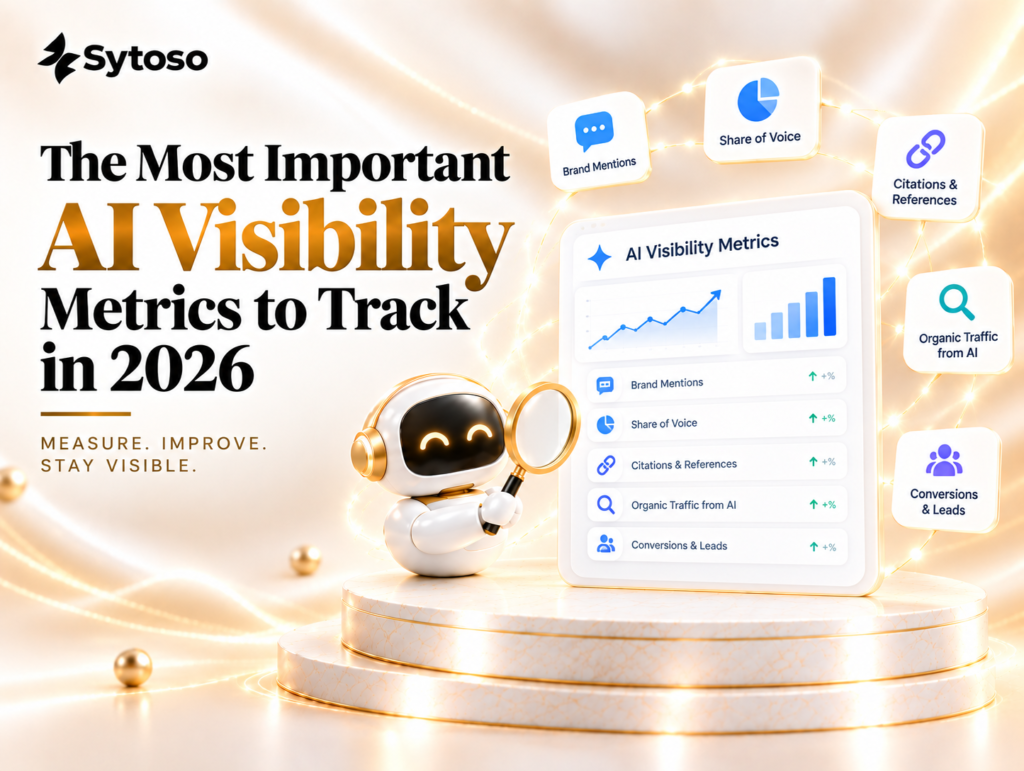
AI visibility metrics measure how often, how prominently, and how favorably your brand appears inside answers from tools like Google AI Overviews, ChatGPT, Perplexity, and Gemini. Unlike rankings, which track a page’s position, these metrics track whether AI actually mentions, cites, and recommends you.
If you’ve been doing SEO for a while, this will feel strange at first. You can rank #2 on Google and still be missing from the answer a customer reads. That’s why we need a new scoreboard.
Here’s the good news: you don’t need 30 numbers. You need about ten, tracked consistently.
Jump to Section
Why Rankings Alone No Longer Tell the Full Story
Rankings tell you where your page sits in a list of links. AI answers don’t show a list. They pick a few brands and sources and summarize them. Either you’re in that answer, or you’re not.
That also means a customer can form an opinion about you without ever visiting your site. Clicks still matter, but they’re no longer the only proof that people found you.
The 10 AI Visibility Metrics That Matter Most
1. Brand Mention Rate
What it is: How often your brand name appears in AI answers for the prompts your customers actually use.
Formula: (Prompts where you appear ÷ total prompts tested) × 100
This is your starting point. If you’re at zero here, nothing else matters yet. Use non-branded prompts like “best dentist for braces” instead of your own brand name, because branded prompts only test recall, not discovery.
2. Citation Rate and Citation Share
What it is: How often AI links to or names your website as a source.
Formula: (Citations to your domain ÷ total citations across all answers) × 100
A mention means AI knows you exist. A citation means AI trusts your content enough to back its answer with it. Both matter, but they tell you different things.
3. AI Share of Voice
What it is: Your share of brand mentions compared to competitors for the same prompts.
Formula: (Your mentions ÷ total mentions of all brands) × 100
If you appear in 3 out of 10 answers, that’s a 30% share. This is the best metric for leadership reports because it shows market position, not just your own progress. You can improve and still lose ground if competitors improve faster.
4. AI Overview Inclusion Rate
What it is: How often Google shows an AI Overview for your tracked queries, and how often you’re included when it does.
Formula: (Queries where you’re in the AI Overview ÷ queries that trigger one) × 100
Track this separately from ChatGPT or Perplexity. Google still drives most discovery, and its AI layer behaves differently from other engines.
5. Prompt Coverage
What it is: The percentage of your tracked prompts where you show up at all.
This shows breadth. You might dominate one topic and be invisible on five others. Prompt coverage points straight at those gaps.
6. Sentiment and Answer Accuracy
What it is: How AI describes you: positive, neutral, or negative, and whether the facts are correct.
Being mentioned isn’t enough. “A decent option for some cases” sounds very different from “the best fit for this need.” Also watch for outdated hours, wrong services, or old pricing. Wrong information in an AI answer can cost you customers quietly.
7. Citation Quality and Source Diversity
What it is: Which websites AI relies on when it talks about you, and how varied they are.
If AI keeps citing the same three directories or review sites for your category, those are the places to earn mentions next. This metric doubles as your outreach list.
8. Position and Prominence
What it is: Whether you’re named first, third, or last when AI lists several options.
Being the first brand in a list carries more weight than being the fifth. Track your average position across answers.
9. AI Referral Traffic and Conversion Rate
What it is: Visits from AI platforms like ChatGPT, Perplexity, and Gemini, and how many turn into leads or sales.
Volume is usually small right now. Quality can be high because the AI answer has already done part of the convincing. In GA4, set up a custom channel group for AI referrers so this traffic doesn’t hide inside “Direct” or “Referral.”
10. Branded Search Lift
What it is: The growth in people searching your brand name directly.
Many people see you in an AI answer, then Google you later. That journey never shows up as an AI referral. Rising branded searches in Google Search Console are often the first sign that AI visibility is working.
Quick Reference Table
| Metric | Question it Answers | Check How Often |
| Brand mention rate | Do AI tools name us? | Weekly |
| Citation share | Do they use our content as a source? | Weekly |
| AI share of voice | Are we beating competitors? | Monthly |
| AI Overview inclusion | Are we in Google’s AI answers? | Weekly |
| Prompt coverage | Which topics are we missing? | Monthly |
| Sentiment and accuracy | Are we described well and correctly? | Monthly |
| Citation quality | Which sites back us up? | Monthly |
| Position | Are we named first? | Monthly |
| AI referral traffic | Is it sending real visits? | Monthly |
| Branded search lift | Are people remembering us? | Monthly |
Which Metrics Should You Track First?
Don’t try to track everything on day one. Start here:
- Brand mention rate to learn where you stand.
- Citation share to see if your content gets used.
- AI Overview inclusion if Google is your main traffic source.
- AI referral traffic and branded search to connect it to business results.
Add the rest once the first four are stable.
How to Track AI Visibility Without Expensive Tools
You don’t need a big budget to begin.
Step 1: Build a prompt list. Write 20 to 30 questions your customers really ask. Mix three types: category (“best X in Y”), comparison (“A vs B”), and buying-intent (“who should I hire for Z”).
Step 2: Test them manually. Run each prompt in ChatGPT, Perplexity, Gemini, and Google. Use a clean session or incognito window. Record whether you appear, whether you’re cited, and how you’re described.
Step 3: Repeat on a schedule. Use the same prompts every week or month. AI answers change from run to run, so look at four-week trends instead of reacting to a single result.
Step 4: Add tracking tools when you scale. Platforms like Rankscale or Semrush’s AI features can automate the prompt runs once manual testing gets too heavy.
Step 5: Tag AI traffic in GA4. Separate visits from chatgpt.com, perplexity.ai, gemini.google.com, and similar sources so you can see how they convert.
AI Visibility Metrics for Local Businesses
Most guides on this topic are written for software companies. If you run a local business, the picture is a little different.
When someone asks an AI tool “best plumber near me” or “which dental clinic in Lahore is good for implants,” the answer leans heavily on signals like:
- Your Google Business Profile, kept complete and active
- Consistent name, address, and phone number across directories
- Genuine reviews, and how you respond to them
- Local mentions on trusted sites
For local brands, add these to your tracking:
- Local prompt coverage: do you appear for “near me” and city-specific questions?
- Accuracy of local details: are your hours, address, and services correct in AI answers?
- Review sentiment: how do AI tools summarize what customers say about you?
If your profile data is messy or inconsistent, AI tools may skip you or get you wrong. Fixing the basics often improves your AI visibility faster than any new content.
Common Mistakes to Avoid
- Averaging every engine into one score. You might be strong in Perplexity and invisible in Google AI Overviews. They need different fixes.
- Using branded prompts only. This makes your numbers look better than reality.
- Celebrating mentions with bad sentiment. A mention that frames you as risky or second-best can hurt you.
- Judging on one day. AI results shift, so use trends.
- Tracking vanity numbers. If a metric doesn’t change a decision, drop it.
Final Thoughts
Rankings and traffic still matter, but they no longer tell you if AI is recommending your brand. Pick four or five of these metrics, test them on a fixed schedule, and read the trend. That alone puts you ahead of most businesses, who aren’t measuring AI visibility at all.
FAQs
What is the most important AI visibility metric?
Brand mention rate and citation share are the best starting points. Add share of voice to see how you compare with competitors.
How is AI visibility different from SEO rankings?
Rankings measure a page’s position in a list of links. AI visibility measures whether AI names, cites, and recommends your brand inside an answer.
How do I track AI referral traffic in GA4?
Create a custom channel group that matches referrers such as chatgpt.com, perplexity.ai, and gemini.google.com, so those sessions are reported separately from Direct and Referral.
How often should I check these metrics?
Weekly for mentions, citations, and AI Overview inclusion. Monthly for everything else. Judge by four-week trends.
Can small businesses improve AI visibility?
Yes. Clear content that answers real questions, consistent business details, good reviews, and mentions on trusted sites all help, and none of them require an enterprise budget.