To create an AI search marketing strategy, set clear goals, research the questions your audience asks AI tools, create useful, answer-focused content, build brand authority, earn trusted citations, strengthen technical SEO, and monitor your visibility across Google AI Overviews, ChatGPT, Perplexity, Gemini, and other AI search platforms.
A successful strategy combines proven SEO fundamentals with well-structured content, clear entity signals, credible brand mentions, and continuous tracking of AI visibility. The goal is not just to rank webpages. It is to help AI search engines understand your business, the people you serve, and why your brand is a trustworthy recommendation.
Jump to Section
- What Is an AI Search Marketing Strategy?
- Why Your Business Needs an AI Search Marketing Strategy
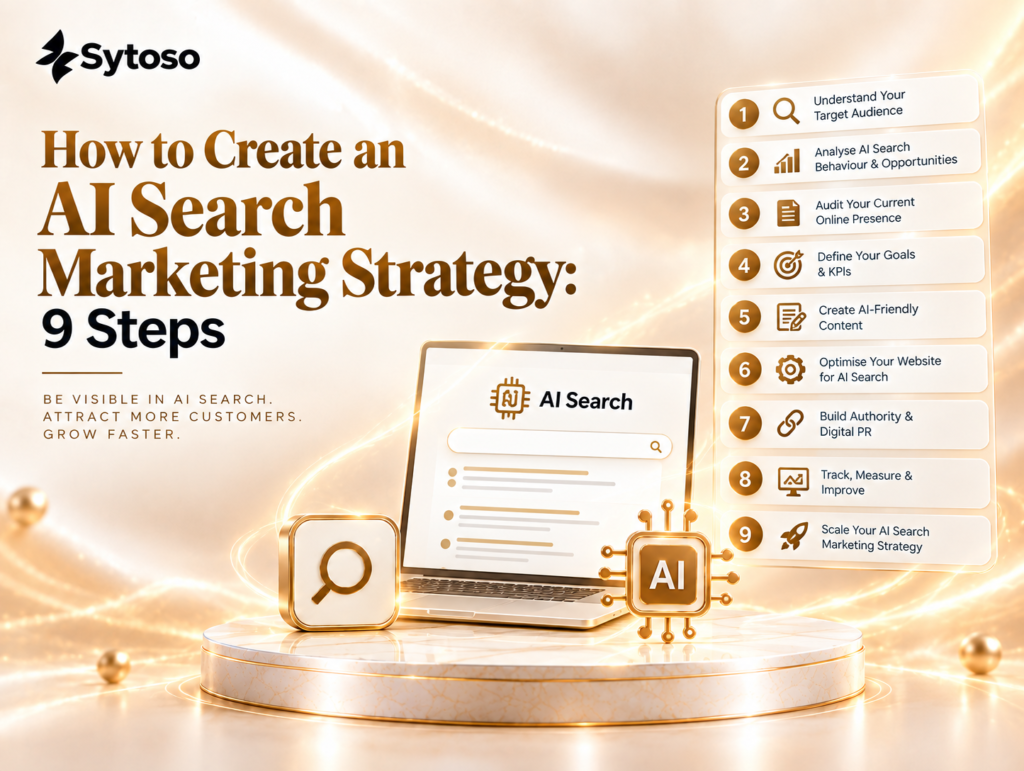
- How to Create an AI Search Marketing Strategy in 9 Steps
- Common AI Search Marketing Mistakes to Avoid
- Build Your AI Search Marketing Strategy With Sytoso
- Frequently Asked Questions
What Is an AI Search Marketing Strategy?
An AI search marketing strategy is a plan for improving how often and how accurately your brand appears in AI-generated search answers.
Traditional SEO mainly focuses on webpage rankings and organic clicks. AI search marketing focuses on broader visibility, including:
- Mentions in AI-generated answers
- Citations and source links
- Brand recommendations
- Presence in Google AI Overviews
- Visibility for conversational, long-tail questions
- Accurate descriptions of your products, services, and expertise
For US businesses, this matters more because buyers use AI tools to research services, compare solutions, and make purchasing decisions before visiting a website.
Why Your Business Needs an AI Search Marketing Strategy
AI search engines do not always show ten blue links. They summarize information, compare providers, and recommend brands directly in the answer.
If your company is not included in those answers, you may lose visibility even when you have strong traditional rankings.
A clear strategy helps you:
- Reach people earlier in the buying journey
- Build authority in your industry
- Improve brand visibility across AI platforms
- Earn more qualified traffic and leads
- Protect your search presence as search behavior changes
- Understand which questions AI tools associate with your brand
How to Create an AI Search Marketing Strategy in 9 Steps
1. Define Your AI Search Goals
Start by deciding what success looks like for your business. Your AI search goals should connect directly to revenue, leads, brand awareness, or customer acquisition.
For example, you may want to:
- Appear in AI answers for your core services
- Be recommended for local or industry-specific searches
- Increase citations in Google AI Overviews
- Improve visibility in ChatGPT and Perplexity
- Generate more demo requests, calls, or sales inquiries
Avoid vague goals such as “rank in AI search.” Instead, focus on measurable outcomes. For instance: “Increase brand mentions for AI SEO services in the United States within six months.”
2. Research How Your Audience Uses AI Search
Your customers may search differently in ChatGPT or Google AI Overviews than they do in traditional Google search.
A standard keyword such as “AI SEO agency” may become a conversational question like:
- Which AI SEO agency is best for B2B companies?
- How can I improve my visibility in ChatGPT?
- What is the best AI search marketing strategy for ecommerce?
- Which agencies help businesses appear in Google AI Overviews?
Research the questions your customers ask at every stage of the buyer journey:
- Awareness: What is AI search marketing?
- Consideration: How does AI search optimization work?
- Comparison: AI search marketing vs traditional SEO
- Decision: Best AI search marketing agency for my business
These questions become the foundation of your content strategy.
3. Build a Clear Brand and Entity Foundation
AI tools need clear, consistent information about your brand. This is known as entity optimization.
Make sure your website clearly states:
- Your business name
- What your company does
- Your main services
- Industries you serve
- Service locations, if applicable
- Founders, experts, and team credentials
- Contact details and social profiles
Keep this information consistent across your website, Google Business Profile, LinkedIn, directories, press mentions, and other trusted platforms.
For Sytoso, this means clearly establishing expertise in AI SEO, answer engine optimization, generative engine optimization, AI visibility, ChatGPT SEO, and AI search marketing.
4. Create Content Around Real AI Search Questions
AI search platforms prefer content that answers specific questions clearly, accurately, and in enough depth to be useful.
Build content clusters around your main services. Each cluster should include:
- A core service page
- Educational blog posts
- Comparison articles
- How-to guides
- FAQs
- Case studies
- Industry-specific pages
This structure makes it easier for search engines and AI systems to understand your topical authority.
5. Optimize Content for Clear, Direct Answers
AI systems often pull information from content that gives direct, well-organized answers.
To improve your content:
- Answer the main question in the first paragraph
- Use descriptive H2 and H3 headings
- Keep paragraphs focused and easy to scan
- Add bullet points, tables, and step-by-step instructions
- Use examples to explain complex topics
- Include accurate facts, original insights, and expert opinions
- Add relevant FAQs at the end of key pages
Do not write only for algorithms. Write content that genuinely solves the searcher’s problem. Clear answers help users, traditional search engines, and AI tools understand your content.
6. Strengthen Your E-E-A-T Signals
Experience, Expertise, Authoritativeness, and Trustworthiness remain important in AI search.
Show why your business deserves to be trusted. You can do this by adding:
- Author bios with real expertise
- Client results and case studies
- Original data or research
- Expert quotes and commentary
- Testimonials and reviews
- Clear company information
- Updated content dates
- References to reliable sources when needed
For service businesses, proof matters. A claim like “we improve AI visibility” is stronger when backed by an audit process, measurable results, client examples, and transparent reporting.
7. Earn Relevant Mentions and Citations
AI search engines often rely on information found across the web, not only on your website.
Build a strong off-site presence through relevant, trustworthy sources such as:
- Industry publications
- Digital PR campaigns
- Guest articles
- Business directories
- Podcasts and interviews
- Partner websites
- Expert roundups
- Review platforms
- High-quality resource pages
Focus on relevance and credibility. One strong mention in a respected industry publication can be more valuable than dozens of low-quality links.
Your goal is to make it easy for AI systems to find consistent evidence that your brand is credible in your field.
8. Use Structured Data and Technical SEO
Technical SEO still supports AI search visibility. If search engines cannot crawl, understand, or trust your content, it is less likely to be surfaced in AI answers.
Review these essentials:
- Fast page loading speed
- Mobile-friendly design
- Logical internal linking
- Clean URL structure
- Proper indexation
- XML sitemap
- Canonical tags
- Schema markup
- Clear heading hierarchy
Use relevant schema such as Organization, LocalBusiness, Service, Article, FAQPage, Review, and Person schema where appropriate.
Structured data does not guarantee AI citations, but it helps search engines interpret your content and business details correctly.
9. Track AI Search Visibility and Improve Continuously
AI search marketing is not a one-time project. AI results can change quickly as platforms update their models, sources, and answer formats.
Track your visibility for important prompts and questions across platforms such as:
- Google AI Overviews
- ChatGPT
- Perplexity
- Gemini
- Microsoft Copilot
Monitor:
- Brand mentions
- Competitor mentions
- Citation sources
- Recommended products or services
- Prompt-level visibility
- Referral traffic
- Leads and conversions
- Changes in sentiment or brand descriptions
Use this data to find content gaps, improve pages that are not being cited, and create new content around emerging customer questions.
Common AI Search Marketing Mistakes to Avoid
Many businesses make the mistake of treating AI search as a shortcut. It is not.
Avoid these common issues:
- Publishing generic AI-written content with no original value
- Ignoring basic SEO and technical website health
- Targeting only short, high-volume keywords
- Failing to show real experience or proof
- Using inconsistent business information online
- Creating content without a clear topic cluster
- Chasing every AI platform without a focused strategy
- Measuring rankings but not AI mentions, citations, and leads
The strongest strategy combines helpful content, technical quality, brand authority, and consistent measurement.
Build Your AI Search Marketing Strategy With Sytoso
AI search is changing how people discover, compare, and choose businesses. A strong strategy gives your brand a better chance of being included in the answers customers see before they visit a website.
At Sytoso, we help businesses improve their visibility across AI-powered search experiences through AI SEO, content optimization, entity strategy, AI citation building, and AI visibility reporting.
If you want to understand where your brand stands today, Sytoso can help you build a practical AI search marketing strategy focused on visibility, authority, and business growth.
Frequently Asked Questions
What is AI search marketing?
AI search marketing is the process of improving a brand’s visibility in AI-powered search tools such as Google AI Overviews, ChatGPT, Perplexity, Gemini, and Copilot. It combines SEO, content, entity optimization, digital PR, and AI visibility tracking.
How is AI search marketing different from SEO?
SEO primarily aims to improve rankings and organic traffic from traditional search results. AI search marketing includes SEO but also focuses on brand mentions, citations, recommendations, and visibility in AI-generated answers.
How long does it take to see results from AI search marketing?
Most businesses need several months to build meaningful authority, improve content, and earn trusted mentions. Timelines vary based on your website’s current strength, competition, industry, and the quality of your strategy.
Can small businesses benefit from AI search marketing?
Yes. Small businesses can benefit by focusing on clear local information, niche expertise, helpful content, positive reviews, and trusted citations. AI search often rewards highly relevant, well-explained information, not only large brands.
What should be included in an AI search marketing strategy?
A complete AI search marketing strategy should include goal setting, audience research, entity optimization, content clusters, direct-answer content, E-E-A-T signals, citation building, technical SEO, and ongoing AI visibility tracking.