Search is changing rapidly. For years, businesses focused on traditional SEO to improve Google rankings, attract organic traffic, and increase website visibility. However, the rise of artificial intelligence has introduced a new way users discover information through AI-powered platforms such as ChatGPT, Gemini, Claude, and Perplexity.
This shift has created a new optimisation approach known as LLM SEO (Large Language Model SEO). While traditional SEO focuses on improving rankings in search engine results pages, LLM SEO focuses on helping AI systems understand, trust, and recommend a brand in generated responses.
Understanding the difference between LLM SEO vs Traditional SEO is important for businesses that want to maintain visibility in both traditional search engines and emerging AI search experiences.
Jump to Section
- What Is Traditional SEO?
- What Is LLM SEO?
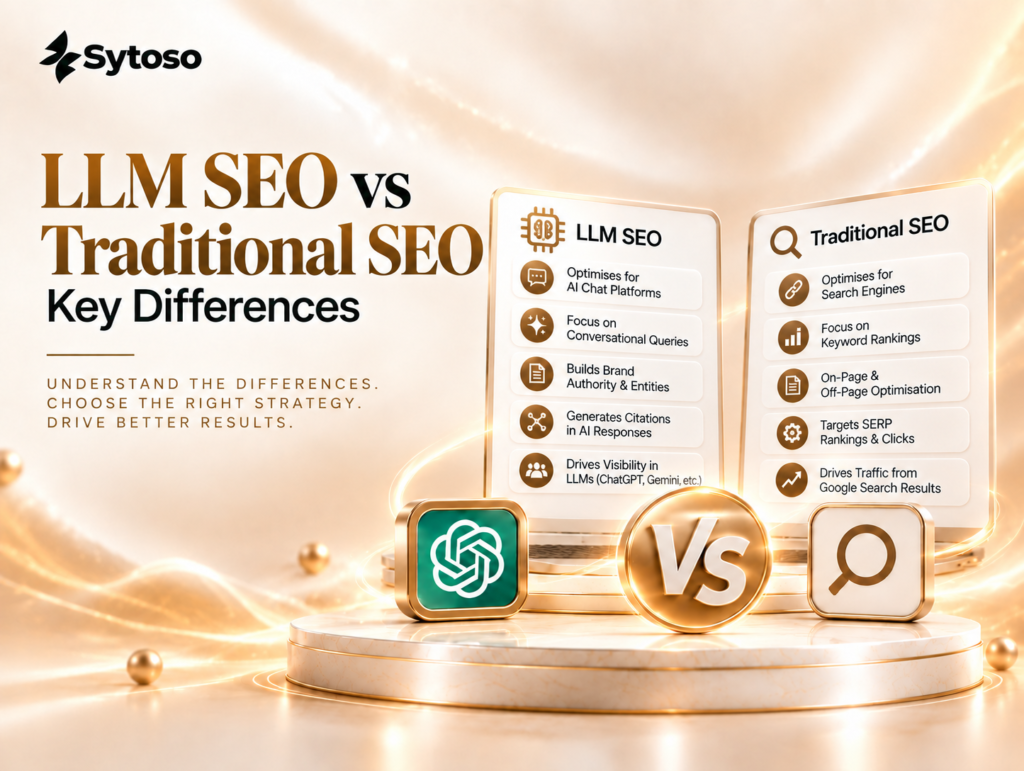
- LLM SEO vs Traditional SEO: Main Differences
- How Traditional SEO and LLM SEO Understand Content Differently
- Why Traditional SEO Alone Is Not Enough in the AI Search Era
- Can LLM SEO Replace Traditional SEO?
- LLM SEO vs Traditional SEO: Which Strategy Should Businesses Use?
- The Future of SEO
- Conclusion
- Frequently Asked Questions
What Is Traditional SEO?
Traditional SEO (Search Engine Optimisation) is the process of improving a website’s visibility in search engine results. The main goal is to help web pages rank higher for relevant keywords and attract visitors through organic search.
Traditional SEO strategies usually include:
- Keyword research and optimisation
- On-page SEO improvements
- Technical SEO
- Website speed optimisation
- Internal linking
- Backlink building
- Content creation
- User experience improvements
Search engines like Google analyse multiple ranking signals, including content relevance, website authority, backlinks, and technical performance, to determine which pages should appear in search results.
The primary success metrics of traditional SEO include:
- Keyword rankings
- Organic traffic
- Click-through rates
- Website conversions
- Domain authority
Traditional SEO remains an important part of digital marketing because search engines continue to drive significant online traffic.
What Is LLM SEO?
LLM SEO is the process of optimising content, brand information, and digital signals so that Large Language Models can better understand and reference a business in AI-generated answers.
Large Language Models power AI platforms such as ChatGPT, Gemini, Claude, and Perplexity. These systems do not simply match keywords. Instead, they analyse context, relationships, entities, and information credibility to generate responses.
LLM SEO focuses on improving:
- AI visibility
- Brand mentions
- AI citations
- Entity recognition
- Content understanding
- Digital authority
The goal of LLM SEO is not only to rank a webpage but to make a brand a trusted source that AI systems can recommend when users ask relevant questions.
LLM SEO vs Traditional SEO: Main Differences
Although both strategies aim to improve online visibility, they work differently.
| Factor | Traditional SEO | LLM SEO |
| Main Objective | Rank web pages on search engines | Get recognised and mentioned by AI systems |
| Main Platforms | Google, Bing | ChatGPT, Gemini, Claude, Perplexity |
| Focus | Keywords, backlinks, technical SEO | Entities, context, accuracy, authority |
| User Journey | User clicks search results | User receives AI-generated answers |
| Content Approach | Optimise for rankings | Optimise for understanding and recommendations |
| Success Metrics | Rankings and organic traffic | AI visibility, citations, and mentions |
Traditional SEO helps businesses appear in search results, while LLM SEO helps businesses become part of AI-generated answers.
How Traditional SEO and LLM SEO Understand Content Differently
Traditional search engines mainly analyse keywords, links, and website signals to understand relevance.
For example, a website targeting “AI SEO Agency Sydney” may optimise:
- Page titles
- Headings
- Meta descriptions
- Content keywords
- Backlinks
LLM SEO goes deeper by analysing the overall meaning and relationships behind content.
AI systems focus on:
- Brand identity
- Topic relationships
- Expertise
- Content accuracy
- Consistent information across the web
This means businesses need to create content that is not only keyword-focused but also clear, comprehensive, and useful.
Why Traditional SEO Alone Is Not Enough in the AI Search Era
Search behaviour is changing. Many users are now asking questions directly to AI assistants instead of searching through traditional search engines.
For example:
Traditional search query:
“Best AI SEO agency”
AI search query:
“Which AI SEO agencies help businesses improve ChatGPT visibility?”
The second query requires AI systems to understand businesses, compare information, and provide recommendations.
This creates new opportunities and challenges for brands. Ranking on Google may not guarantee visibility in AI-generated answers.
Businesses now need to focus on:
- Building strong brand authority
- Creating trustworthy content
- Improving entity recognition
- Increasing online mentions
- Providing clear answers
Can LLM SEO Replace Traditional SEO?
LLM SEO is not replacing traditional SEO. Instead, both strategies work together.
Traditional SEO provides the foundation by improving:
- Website structure
- Search rankings
- Organic visibility
- User experience
LLM SEO expands visibility by improving:
- AI recommendations
- Brand recognition
- AI-generated citations
- Future search presence
Businesses that combine both approaches can reach users across traditional search engines and AI-powered platforms.
LLM SEO vs Traditional SEO: Which Strategy Should Businesses Use?
The answer depends on business goals, but modern businesses should consider both approaches.
Traditional SEO helps businesses:
- Generate website traffic
- Capture keyword searches
- Improve Google rankings
- Increase organic leads
LLM SEO helps businesses:
- Appear in AI answers
- Build brand authority
- Improve AI discoverability
- Prepare for future search behaviour
A complete search strategy should combine traditional SEO fundamentals with AI-focused optimisation techniques.
The Future of SEO
The future of search is moving from simply ranking websites to becoming a trusted source of answers.
Users increasingly want quick, accurate, and personalised information. AI platforms are becoming important discovery channels where businesses need to be visible.
The brands that invest in:
- Strong content
- Entity authority
- Semantic optimisation
- AI search strategies
will be better prepared for the changing search landscape.
Conclusion
The difference between LLM SEO vs Traditional SEO reflects the evolution of online search. Traditional SEO helps businesses rank in search engines, while LLM SEO helps brands become recognised and recommended by AI systems.
As search continues to evolve, businesses need a broader optimisation strategy that combines technical SEO, quality content, entity optimisation, and AI search visibility.
The future of SEO is not only about ranking higher. It is about becoming the trusted answer users and AI systems rely on.
Frequently Asked Questions
What is the difference between LLM SEO and Traditional SEO?
Traditional SEO focuses on ranking webpages in search engines, while LLM SEO focuses on helping AI systems understand and recommend brands in generated responses.
Is LLM SEO replacing traditional SEO?
No. LLM SEO complements traditional SEO by improving visibility across AI-powered search platforms.
Does Google SEO help with LLM visibility?
Many SEO fundamentals, such as quality content, authority, and technical optimisation, can support LLM visibility. However, LLM SEO requires additional focus on entities, context, and AI citations.
What is AI visibility?
AI visibility refers to how often and how accurately a brand appears in AI-generated answers across platforms like ChatGPT, Gemini, and Perplexity.
What are GEO and AEO in relation to LLM SEO?
GEO (Generative Engine Optimisation) and AEO (Answer Engine Optimisation) are related approaches focused on improving visibility in AI-generated answers and answer-based search experiences.