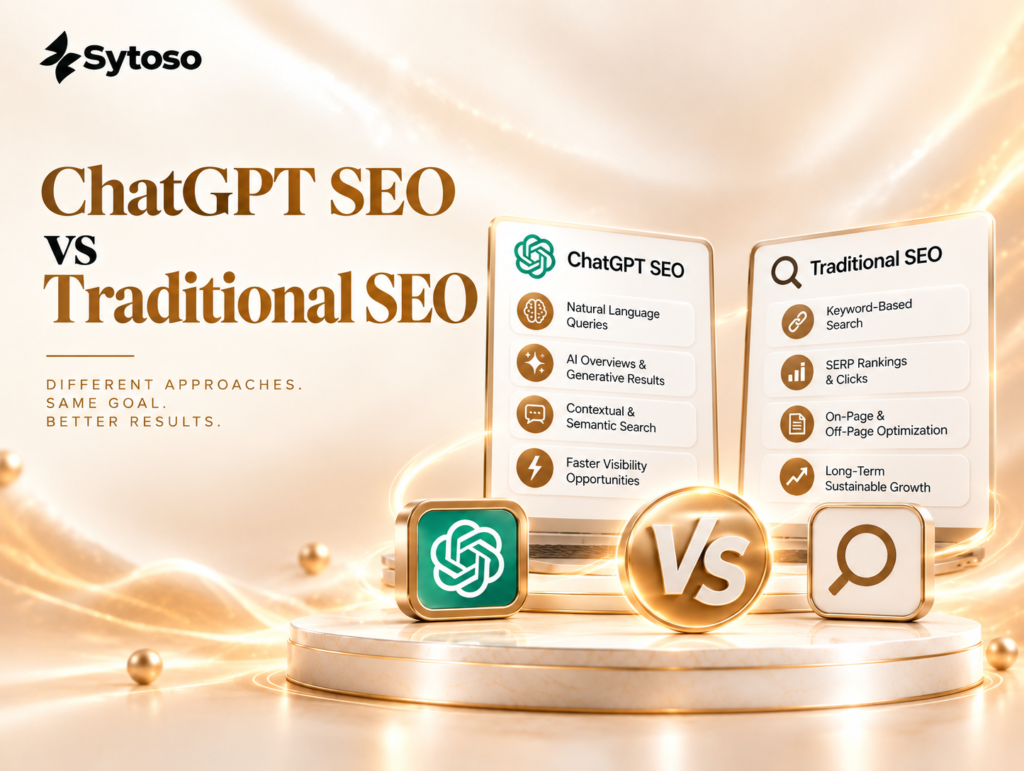
ChatGPT SEO and Traditional SEO are not replacements for each other. Traditional SEO focuses on improving website rankings on search engines like Google through keywords, backlinks, technical optimization, and content quality. ChatGPT SEO focuses on improving visibility in AI-generated answers by optimizing content for AI systems, semantic relevance, entities, and trusted information sources.
As search behavior changes, users are no longer relying only on traditional search results. Many people now ask AI tools like ChatGPT direct questions and expect instant, conversational answers. This shift has introduced a new approach called AI search optimization, where businesses need to optimize content not only for rankings but also for AI discovery and recommendations.
The difference between ChatGPT SEO and Traditional SEO comes down to how information is found, understood, and presented. Traditional SEO helps pages appear in search results, while ChatGPT SEO helps content become a reliable source for AI-generated responses.
In this guide, we will compare ChatGPT SEO and Traditional SEO, explain their key differences, and explore how businesses can combine both strategies to improve online visibility.
Jump to Section
- What Is Traditional SEO?
- What Is ChatGPT SEO?
- ChatGPT SEO vs Traditional SEO: Key Differences
- How Keyword Strategy Changes in ChatGPT SEO
- Content Optimization for ChatGPT Search
- The Role of Entities and Semantic SEO in ChatGPT Optimization
- Do Backlinks Still Matter for ChatGPT SEO?
- Can ChatGPT SEO Replace Traditional SEO?
- The Future of SEO: From Rankings to AI Visibility
- Final Thoughts
- FAQs: ChatGPT Optimization vs Traditional SEO
What Is Traditional SEO?
Traditional SEO is the process of optimizing websites to improve visibility in search engine results pages (SERPs). It focuses on helping search engines understand website content and rank pages based on relevance, authority, and user experience.
Traditional SEO strategies usually include:
- Keyword research and targeting
- On-page optimization
- Technical SEO improvements
- Backlink building
- Internal linking
- Website speed optimization
- Meta title and description optimization
- Content optimization
The main goal of traditional SEO is to increase organic traffic by achieving higher rankings on search engines like Google and Bing.
For example, when someone searches for “best project management software,” traditional SEO helps a website appear among the top search results by matching keywords, providing valuable content, and building authority through trusted links.
What Is ChatGPT SEO?
ChatGPT SEO is the process of optimizing content so that AI systems and conversational search platforms can understand, retrieve, and reference information in their responses.
Unlike traditional search engines that display a list of web pages, AI tools generate direct answers by analyzing information from multiple sources.
ChatGPT SEO focuses on:
- Semantic content optimization
- Clear and direct answers
- Entity recognition
- Topical authority
- Brand mentions
- AI citations
- Structured content
- Expert-level information
The goal of ChatGPT SEO is not only to rank a webpage but also to increase the chances that an AI system recognizes your content as a trustworthy source.
For example, instead of ranking for only “best CRM software,” ChatGPT SEO focuses on answering related questions such as:
“What CRM software is best for small businesses and why?”
This helps AI systems understand the complete context behind a topic.
ChatGPT SEO vs Traditional SEO: Key Differences
| Factor | Traditional SEO | ChatGPT SEO |
| Primary Goal | Rank webpages in search engines | Get mentioned in AI-generated answers |
| Search Style | Keyword-based searches | Conversational questions |
| Optimization Focus | Keywords, backlinks, technical factors | Context, entities, semantic relevance |
| Main Platforms | Google, Bing, Yahoo | ChatGPT and AI search platforms |
| Success Metrics | Rankings, clicks, organic traffic | AI visibility, citations, mentions |
| Content Approach | Optimize for search queries | Optimize for answers and understanding |
| Authority Signals | Backlinks and domain authority | Expertise, trust, entities, references |
How Keyword Strategy Changes in ChatGPT SEO
Traditional SEO has historically focused on finding keywords with search volume and optimizing pages around those terms.
For example:
Traditional SEO keyword:
“best email marketing software”
ChatGPT SEO approach:
“What is the best email marketing software for a startup with a small budget?”
AI search focuses more on meaning, context, and user intent rather than exact keyword matching.
Modern keyword strategies should include:
- Long-tail keywords
- Question-based queries
- Conversational phrases
- Related topics
- Semantic keywords
This means businesses need to create content that answers complete user problems instead of targeting only individual keywords.
The Role of Entities and Semantic SEO in ChatGPT Optimization
Content optimized for ChatGPT should be easy for both users and AI systems to understand.
Important practices include:
Provide Direct Answers
AI systems prefer content that clearly answers questions. Adding short explanations, definitions, and summaries improves content understanding.
Use Clear Structure
Organize content with:
- Descriptive headings
- Short paragraphs
- Bullet points
- FAQ sections
- Step-by-step explanations
Demonstrate Expertise
Content should include:
- Real examples
- Industry experience
- Data-backed insights
- Expert opinions
- Original research
Improve Information Accuracy
AI systems rely on trustworthy information. Updated statistics, references, and factual explanations help improve credibility.
The Role of Entities and Semantic SEO in ChatGPT Optimization
One major difference between ChatGPT SEO and traditional SEO is the importance of entities.
Traditional SEO often focuses on keywords, while AI systems focus on understanding relationships between concepts.
For example, AI systems do not only understand the keyword “Apple.” They analyze whether the content refers to:
- Apple Inc. (technology company)
- Apple fruit
- Apple products
- Related concepts like iPhone, Mac, or iOS
Entity optimization helps AI systems understand:
- Who you are
- What your brand does
- Which topics you are associated with
- Why your content is trustworthy
Important elements include:
- Schema markup
- Structured data
- Brand information
- Author profiles
- Consistent business details
Do Backlinks Still Matter for ChatGPT SEO?
Backlinks remain an important part of online authority, but AI search introduces additional credibility signals.
Traditional SEO mainly evaluates backlinks as a ranking factor.
ChatGPT SEO considers broader trust signals, including:
- Brand mentions
- Expert references
- Industry recognition
- Reliable sources
- Content quality
A website with strong authority and trustworthy information has a better chance of being recognized as a valuable source by AI systems.
Can ChatGPT SEO Replace Traditional SEO?
ChatGPT SEO does not replace Traditional SEO. Both strategies serve different purposes.
Traditional SEO helps businesses gain visibility through search engine rankings and organic traffic.
ChatGPT SEO helps businesses appear in AI-generated answers and conversational search experiences.
A modern SEO strategy should combine both approaches:
- Use traditional SEO for website rankings
- Use ChatGPT SEO for AI visibility
- Create content that serves both search engines and users
The Future of SEO: From Rankings to AI Visibility
SEO is evolving from simply ranking webpages to becoming visible across multiple search experiences.
Users now discover information through:
- Google search results
- AI assistants
- Chatbots
- Voice search
- Generative search platforms
The future of SEO will require businesses to optimize content for both traditional search engines and AI systems.
The brands that focus on quality information, authority, and user experience will be better positioned for this changing search environment.
Final Thoughts
The debate around ChatGPT SEO vs Traditional SEO is not about choosing one strategy over another.
Traditional SEO provides the foundation for online visibility through rankings, traffic, and website optimization.
ChatGPT SEO adds a new layer by helping brands become discoverable in AI-generated answers.
The most effective approach is combining both strategies: creating authoritative, helpful, and well-structured content that works for search engines, AI systems, and real users.
FAQs: ChatGPT Optimization vs Traditional SEO
What is the difference between ChatGPT SEO and Traditional SEO?
Traditional SEO focuses on ranking websites in search engines, while ChatGPT SEO focuses on improving visibility in AI-generated answers and recommendations.
Does ChatGPT SEO replace Traditional SEO?
No. ChatGPT SEO works alongside Traditional SEO by adding a new layer of AI search visibility.
How can I optimize content for ChatGPT SEO?
Create clear, helpful content, answer user questions directly, build topical authority, and use structured data.
Are keywords still important for ChatGPT SEO?
Yes, but AI search focuses more on context, user intent, and semantic relevance rather than exact keyword matching.
Do backlinks matter for ChatGPT SEO?
Yes. Backlinks, brand mentions, and trusted references can help improve overall authority and credibility.
What is the future of SEO with AI search?
The future of SEO will combine traditional rankings with AI visibility, requiring businesses to optimize for both search engines and AI platforms.