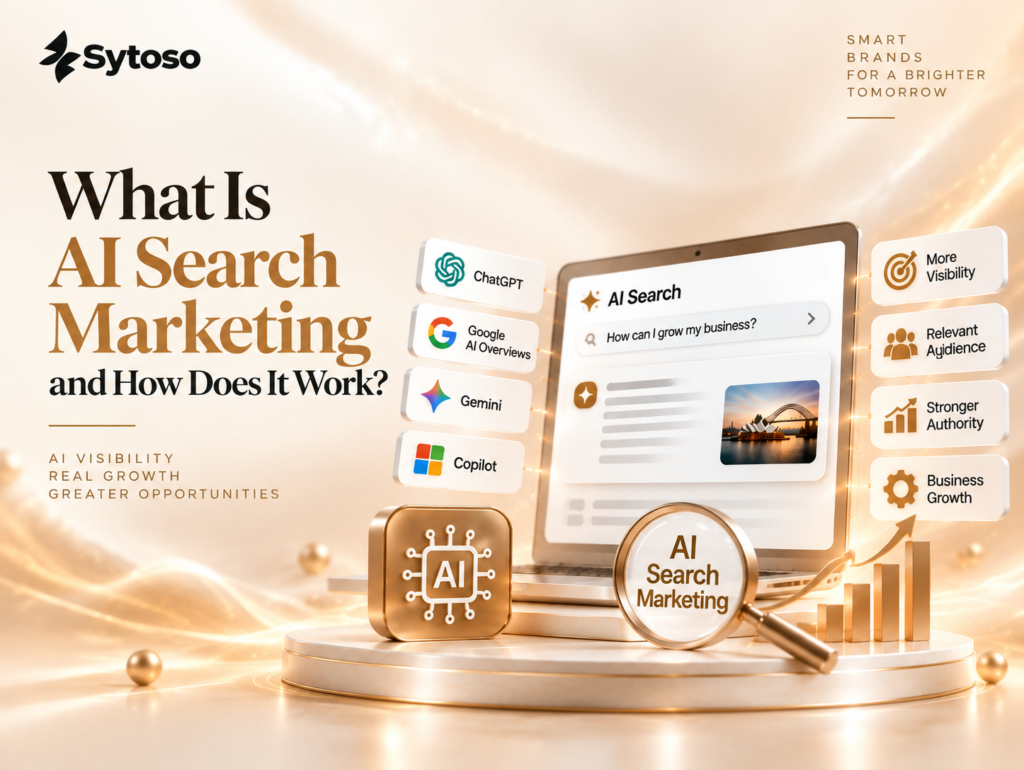
AI Search Marketing is the process of optimising a brand’s online presence so that AI-powered search systems can understand, evaluate, and potentially reference the business in generated answers.
Search behavior is changing rapidly. People no longer rely solely on traditional search engines by typing short keywords and choosing from a list of blue links. Today, users ask complete questions through AI-powered platforms such as ChatGPT, Google AI Overviews, Gemini, Microsoft Copilot, and Perplexity to find information, compare services, and make decisions.
This shift has created a new opportunity for businesses: becoming visible inside AI-generated answers. AI Search Marketing focuses on improving how AI search systems understand, trust, and reference brands. Instead of only targeting rankings, it helps businesses build stronger digital signals that increase their chances of appearing in AI-powered search experiences.
As AI continues to influence customer discovery, businesses need strategies that combine traditional SEO, high-quality content, technical optimisation, entity signals, and brand authority.
Jump to Section
What Is AI Search Marketing?
AI Search Marketing is the process of optimising a brand’s online presence so that AI-powered search systems can understand, evaluate, and potentially reference the business in generated answers.
Traditional SEO mainly focuses on improving rankings in search engine results pages. AI Search Marketing expands this approach by focusing on how artificial intelligence understands information, connects concepts, and provides recommendations to users.
AI search systems use advanced technologies such as Large Language Models (LLMs), Natural Language Processing (NLP), machine learning, and information retrieval to generate responses. These systems do not simply match keywords. They analyse context, meaning, relationships between entities, and the reliability of available information.
For businesses, this means success depends on more than keyword placement. Strong content quality, clear brand information, technical accessibility, and online authority all contribute to AI search visibility.
How Does AI Search Marketing Work?
AI Search Marketing works through multiple stages where AI systems understand user queries, retrieve information, evaluate sources, and generate answers.
1. AI Systems Understand User Intent
The first step is understanding what a user actually wants.
Unlike traditional searches that often rely on short phrases, AI searches are usually conversational. Users may ask:
- “Which digital marketing agency is best for small businesses?”
- “How can I improve my website visibility in AI search?”
- “What are the benefits of AI SEO services?”
AI systems use Natural Language Processing (NLP) to understand:
- Search intent
- Context
- User expectations
- Related concepts
- Meaning behind the query
This means businesses need content that answers real customer questions instead of only targeting individual keywords.
2. AI Retrieves Relevant Information
After understanding the query, AI systems collect relevant information from available sources.
Depending on the platform, AI tools may use:
- Search indexes
- Website content
- Trusted online sources
- Structured information
- Knowledge databases
This is why having well-organised, accessible, and authoritative website content is important.
Businesses should focus on creating content that clearly explains their services, expertise, processes, and industry knowledge.
3. AI Evaluates Trust and Authority Signals
AI systems need to determine which information sources are reliable.
They may consider signals such as:
- Content accuracy
- Expertise and experience
- Brand reputation
- Online mentions
- Reviews
- Backlinks
- Entity information
- Structured data
Entity optimisation has become an important part of AI Search Marketing because AI models need to understand who a brand is, what it offers, and how it connects with other trusted information sources.
For example, consistent business information across websites, directories, profiles, and industry platforms helps create stronger brand recognition.
4. AI Generates Answers and Recommendations
After analysing information, AI systems generate responses for users.
Instead of showing only website rankings, AI platforms may provide:
- Direct answers
- Business recommendations
- Brand mentions
- Source citations
- Comparisons
The goal of AI Search Marketing is not to manipulate AI responses but to build reliable digital signals that help AI systems understand a business.
Key Elements of an AI Search Marketing Strategy
A successful AI Search Marketing strategy combines several areas of optimisation.
Create AI-Friendly Content
Content remains one of the most important parts of AI search visibility.
AI systems prefer content that is:
- Clear
- Helpful
- Well-structured
- Informative
- Based on real expertise
Businesses should create content that answers customer questions, explains complex topics, and provides useful information.
Important practices include:
- Creating detailed guides
- Using clear headings
- Adding FAQs
- Supporting claims with evidence
- Covering topics comprehensively
Build Strong Brand Entities
AI systems need to understand brands as entities rather than just collections of keywords.
Entity optimisation focuses on strengthening:
- Brand identity
- Business information
- Industry relationships
- Digital reputation
- Knowledge signals
Important elements include:
- Consistent business details
- Schema markup
- Author information
- Brand mentions
- Trusted references
Strengthen Technical SEO Foundations
Although AI search introduces new opportunities, traditional technical SEO remains important.
A website should have:
- Proper crawlability
- Fast loading speed
- Mobile optimisation
- Structured data
- Clear internal linking
- Well-organised content
Technical SEO helps AI systems access and understand website information more effectively.
Improve Digital Authority
AI platforms rely on trust signals when selecting information.
Businesses can improve authority through:
- Industry publications
- Quality backlinks
- Customer reviews
- Expert contributions
- Brand mentions
A strong digital reputation increases the likelihood that AI systems recognise a business as a reliable source.
AI Search Marketing vs Traditional SEO
| Traditional SEO | AI Search Marketing |
| Focuses on keyword rankings | Focuses on AI visibility |
| Targets search result pages | Targets AI-generated answers |
| Measures rankings and traffic | Measures mentions, citations, and visibility |
| Uses keywords and backlinks | Uses context, entities, and authority signals |
| Optimises pages for search engines | Optimises information for AI understanding |
Traditional SEO and AI Search Marketing are not separate strategies. They work together. A strong SEO foundation supports better AI visibility because quality content, technical optimisation, and authority remain important factors.
Why Is AI Search Marketing Important for Businesses?
Customer journeys are becoming more conversational. People increasingly use AI assistants to research products, compare services, and find recommendations before visiting websites.
AI Search Marketing helps businesses prepare for this changing environment by improving their presence across modern search experiences.
Key benefits include:
- Increased brand visibility
- Better customer discovery
- Stronger digital authority
- Improved online reputation
- More opportunities to be referenced by AI systems
Businesses that adapt early can build stronger foundations for future search behaviour.
How Can Businesses Prepare for AI Search?
Businesses can improve their AI search readiness by following these steps:
1. Create Helpful and Authoritative Content
Answer customer questions clearly and provide valuable information.
2. Optimise Brand Entities
Make sure AI systems can understand your business, services, expertise, and industry relationships.
3. Use Structured Data
Schema markup helps search engines and AI systems interpret important information.
4. Build Online Trust Signals
Develop reviews, mentions, partnerships, and authoritative references.
5. Monitor AI Search Visibility
Track how your brand appears across AI platforms and identify opportunities for improvement.
Conclusion
AI Search Marketing represents the next evolution of digital visibility. As users move from traditional searches toward AI-powered conversations, businesses need to focus on becoming understandable, trustworthy, and relevant to intelligent search systems.
The future of search is not only about ranking pages. It is about building strong digital identities that AI platforms can recognise and recommend. By combining SEO fundamentals with AI-focused optimisation strategies, businesses can prepare for the changing search landscape and create stronger connections with modern customers.
FAQs about AI Search Marketing
What is AI Search Marketing?
AI Search Marketing is the process of improving a brand’s visibility in AI-powered search experiences by optimising content, authority signals, and digital information.
How is AI Search Marketing different from SEO?
SEO focuses mainly on improving rankings in search engines, while AI Search Marketing focuses on helping AI systems understand and reference a brand in generated answers.
Does AI Search Marketing replace traditional SEO?
No. AI Search Marketing builds on traditional SEO principles such as technical optimisation, quality content, and authority building.
How do AI systems decide which brands to mention?
AI systems evaluate factors such as relevance, content quality, authority, trust signals, and available information sources.
Can businesses improve their AI search visibility?
Yes. Businesses can improve AI visibility by creating authoritative content, strengthening brand entities, improving technical SEO, and building trustworthy online signals.