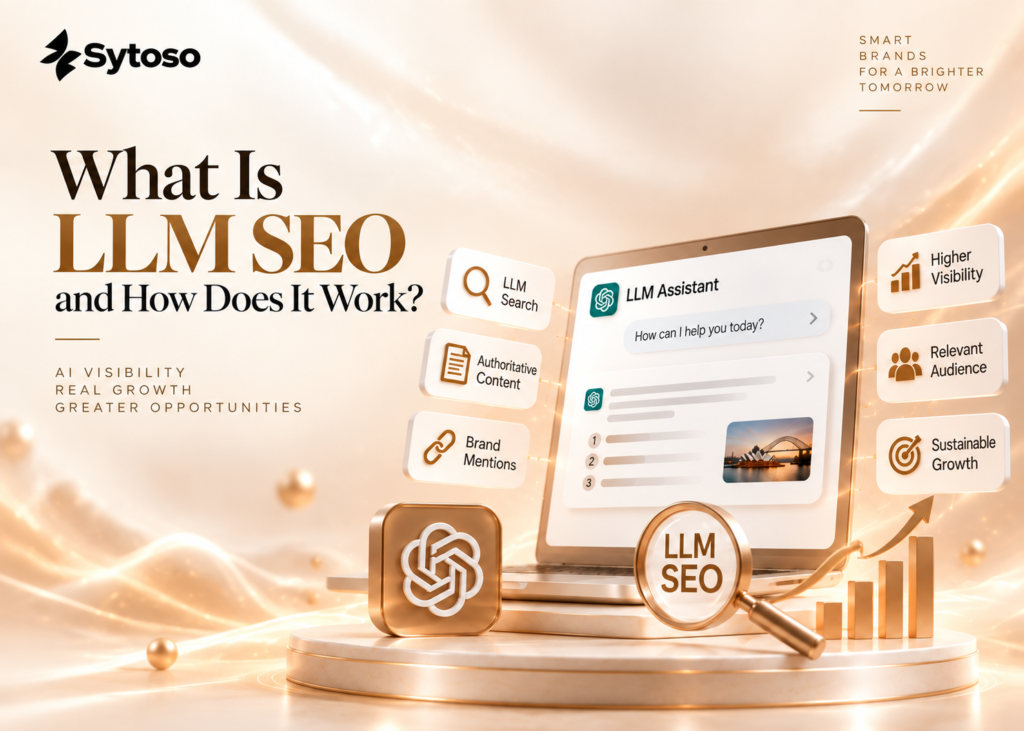
LLM SEO, or Large Language Model SEO, is the process of optimizing website content so AI platforms such as Google AI Overviews, ChatGPT, Gemini, Perplexity, and Claude can understand, trust, and potentially reference it in their answers. It works by improving content clarity, topical relevance, expertise signals, structured information, and technical accessibility, helping AI systems identify your business as a useful source for relevant conversational searches.
That is where LLM seo services come in. Rather than relying on shortcuts or promising guaranteed citations, LLM SEO strengthens the content, brand, and website signals that support visibility across AI-driven search experiences.
Jump to Section
- What Is LLM SEO?
- Why Does LLM SEO Matter?
- How Does LLM SEO Work?
- LLM SEO vs. Traditional SEO
- The Core Elements of an Effective LLM SEO Strategy
- How to Measure LLM SEO Performance
- What LLM SEO Cannot Guarantee
- Conclusion
- FAQs About LLM SEO
What Is LLM SEO?
LLM SEO, or Large Language Model SEO, is the practice of optimizing a website so large language models can better understand its content and potentially use it in AI-generated answers.
Large language models, often called LLMs, power tools such as ChatGPT, Google Gemini, Perplexity, Claude, and Microsoft Copilot. These platforms interpret natural-language questions, identify relevant information, and generate direct responses for users.
Traditional SEO focuses on improving rankings in search engine results pages. LLM SEO expands that goal. It focuses on making your business discoverable, mentioned, or cited when someone asks an AI platform a relevant question.
For example, a user may ask:
- “What are the best AI SEO services for SaaS companies?”
- “How can a law firm improve visibility in ChatGPT?”
- “What should I look for in an LLM SEO agency?”
- “Which local SEO strategies work in AI search?”
A strong LLM SEO strategy helps ensure your content gives clear, useful, and credible answers to questions like these.
Why Does LLM SEO Matter?
AI search is changing how people research products, services, and business solutions. Instead of reviewing ten blue links, users can receive a summarized answer in seconds.
This creates both a challenge and an opportunity. A business may rank well in Google but remain absent from AI-generated answers. At the same time, a well-structured, authoritative page may earn visibility when an AI platform looks for relevant sources.
LLM SEO matters because it can help businesses:
- Improve AI search visibility
- Build brand awareness in conversational search
- Earn relevant citations and brand mentions
- Support high-intent referral traffic
- Strengthen trust across search engines and AI platforms
- Prepare for a more agent-driven, AI-assisted web
The goal is not to replace traditional SEO. Strong technical SEO, useful content, backlinks, internal linking, and a clear website structure still matter. LLM SEO builds on those foundations.
How Does LLM SEO Work?
LLM SEO works by helping AI systems connect a user’s question with clear, credible, and relevant information from across the web.
1. AI Systems Interpret the User’s Intent
Users rarely search AI platforms with short keyword phrases. They ask detailed questions, explain their situation, and often add follow-up questions.
For example, instead of searching “LLM SEO agency,” a business owner may ask, “How can my healthcare practice appear in ChatGPT recommendations without relying only on Google rankings?”
The AI system interprets the meaning, context, entities, and intent behind that question. This is why LLM SEO relies on semantic relevance rather than exact-match keyword repetition.
Your content should cover the topic naturally, explain related concepts, and answer the questions users are likely to ask next.
2. AI Platforms Find and Evaluate Relevant Information
Search-enabled AI tools may retrieve current information from websites, databases, search results, reviews, forums, and other public sources. They then evaluate which sources are most relevant to the prompt.
A page is more useful when it has:
- Clear headings and logical structure
- Direct answers near the beginning of each section
- Detailed but easy-to-read explanations
- Accurate facts and transparent sourcing
- Relevant entities, terms, and topic coverage
- A strong connection to the user’s search intent
This does not mean every page will be selected or cited. AI outputs can vary by platform, user location, prompt wording, freshness, and available sources.
3. AI Systems Look for Trust and Authority Signals
AI platforms need reliable information. A vague page with generic claims is less useful than a page that clearly demonstrates experience, expertise, authoritativeness, and trustworthiness.
Strong trust signals can include:
- Expert author bios
- First-hand experience and case studies
- Original research or useful data
- Credible references
- Clear business details
- Consistent brand and entity information
- Reputable third-party mentions
- Positive reviews where relevant
For businesses in healthcare, legal, accounting, real estate, and local services, accuracy and credibility are especially important. Your website should make it easy to understand who you are, what you do, who you serve, and why your information can be trusted.
4. AI Tools Extract Clear, Reusable Content
AI systems often need information that can be summarized easily. Long, unclear paragraphs make extraction difficult. Clear, self-contained sections are more useful.
Use:
- Question-based H2 and H3 headings
- Short answer-first paragraphs
- Bullet points and numbered steps
- Definitions and comparisons
- Key takeaways
- FAQs that answer real customer questions
- Tables where they simplify a decision
For example, instead of writing a long paragraph about the difference between LLM SEO and traditional SEO, explain the distinction directly.
| Traditional SEO | LLM SEO |
| Focuses on rankings and organic clicks | Focuses on AI visibility, citations, and brand mentions |
| Targets search engine results pages | Targets AI-generated answers and conversational search |
| Uses keywords, content, links, and technical SEO | Uses those foundations plus semantic depth, entity clarity, and extractable information |
| Measures rankings, traffic, and conversions | Measures citations, mentions, AI referral traffic, and prompt visibility |
LLM SEO vs. Traditional SEO
LLM SEO and traditional SEO share many core principles. Both require high-quality content, technical accessibility, structured data, internal links, mobile usability, and trust signals.
The difference is how success is evaluated.
Traditional SEO aims to help a page rank in Google or Bing, encouraging users to click through to a website. LLM SEO aims to help a business become understandable and citable within AI-generated answers.
This is why ChatGPT SEO services and LLM SEO should not be treated as separate from SEO. They are part of a broader search strategy that supports visibility wherever people ask questions.
The Core Elements of an Effective LLM SEO Strategy
Create Conversational, Intent-Led Content
Your audience uses. Cover real questions, not only target keywords. Use natural-language queries, clear explanations, and meaningful follow-up answers.
Build Semantic Topic Coverage
A strong page should explain the wider topic, not repeat one phrase. For LLM SEO, relevant semantic terms may include AI search optimization, generative search, answer engines, AI citations, topical authority, structured data, entity SEO, AI visibility tracking, and conversational search.
This gives AI systems more context about what the page covers and when it may be useful.
Strengthen Brand and Entity Information
Your business should have consistent information across its website and relevant third-party platforms. Clearly state your brand name, services, locations, industry expertise, authors, and customer types.
Entity clarity helps search engines and AI systems connect your brand with the topics and services it represents.
Use Structured Data and Technical SEO
Schema markup does not guarantee an AI citation. However, Article, Organization, Service, FAQPage, Product, Review, and LocalBusiness schema can help search systems interpret page information more clearly.
Also maintain crawlable pages, fast loading times, mobile usability, logical internal linking, XML sitemaps, and accessible content.
Publish Original Expertise
Generic rewritten content is unlikely to make a business memorable. Publish useful insights based on real experience, original research, industry observations, client outcomes, expert commentary, and practical frameworks.
Original value supports both topical authority and AI visibility.
Keep Important Content Current
AI search often favors information that is accurate and relevant to the question. Review key pages regularly, update outdated statistics, refresh examples, improve internal links, and show clear publication or updated dates where appropriate.
How to Measure LLM SEO Performance
LLM SEO measurement is still developing, so do not rely on one metric alone. Track a combination of:
- Brand mentions in AI answers
- Source citations across relevant prompts
- AI referral traffic in Google Analytics 4
- Leads and conversions from AI traffic
- Visibility for high-value customer questions
- Competitor citation patterns
- Branded search growth
- Engagement with pages designed for AI search
You can also manually test important prompts in ChatGPT, Gemini, Perplexity, and other relevant platforms. Document whether your brand appears, how it is described, which sources are cited, and which competitors are being mentioned.
An AI visibility optimization strategy can turn this monitoring into an ongoing process rather than a one-time check.
What LLM SEO Cannot Guarantee
No agency, tool, or strategy can guarantee that ChatGPT, Gemini, Perplexity, or another AI platform will cite or recommend your business for every relevant prompt.
There is no hidden tag, keyword density formula, or llms.txt file that guarantees permanent AI visibility. AI-generated answers can change based on prompt wording, user context, location, source availability, platform updates, and content freshness.
A credible LLM SEO strategy improves the quality, clarity, and consistency of your signals. It increases your chances of being understood and surfaced. It does not promise a fixed ranking, citation date, or recommendation.
Conclusion
LLM SEO is the practice of making your business easier for large language models to understand, trust, and reference in AI-generated answers. It combines the best parts of traditional SEO with semantic content, entity clarity, structured information, original expertise, and AI visibility monitoring.
Businesses that invest early can improve how they appear in conversational search, AI Overviews, and answer engines. The practical starting point is simple: strengthen your most important pages, answer customer questions directly, show genuine expertise, and monitor how AI platforms describe your brand.
FAQs About LLM SEO
What does LLM SEO mean?
LLM SEO means optimizing content and website information so AI platforms can better understand, evaluate, and potentially reference it in generated answers.
Is LLM SEO different from traditional SEO?
Yes, but it builds on traditional SEO. Traditional SEO focuses more on rankings and clicks, while LLM SEO focuses on AI citations, brand mentions, and visibility in conversational answers.
Can LLM SEO guarantee ChatGPT citations?
No. It can improve your chances of being surfaced, but no strategy can guarantee citations or recommendations for every prompt.
Does schema markup help with LLM SEO?
Structured data can make page information easier for search systems to interpret. It supports clarity, but it is not a guaranteed AI citation factor.
How do I start with LLM SEO?
Start by improving high-value pages with direct answers, semantic topic coverage, strong internal links, expert information, accurate facts, schema markup, and regular content updates.