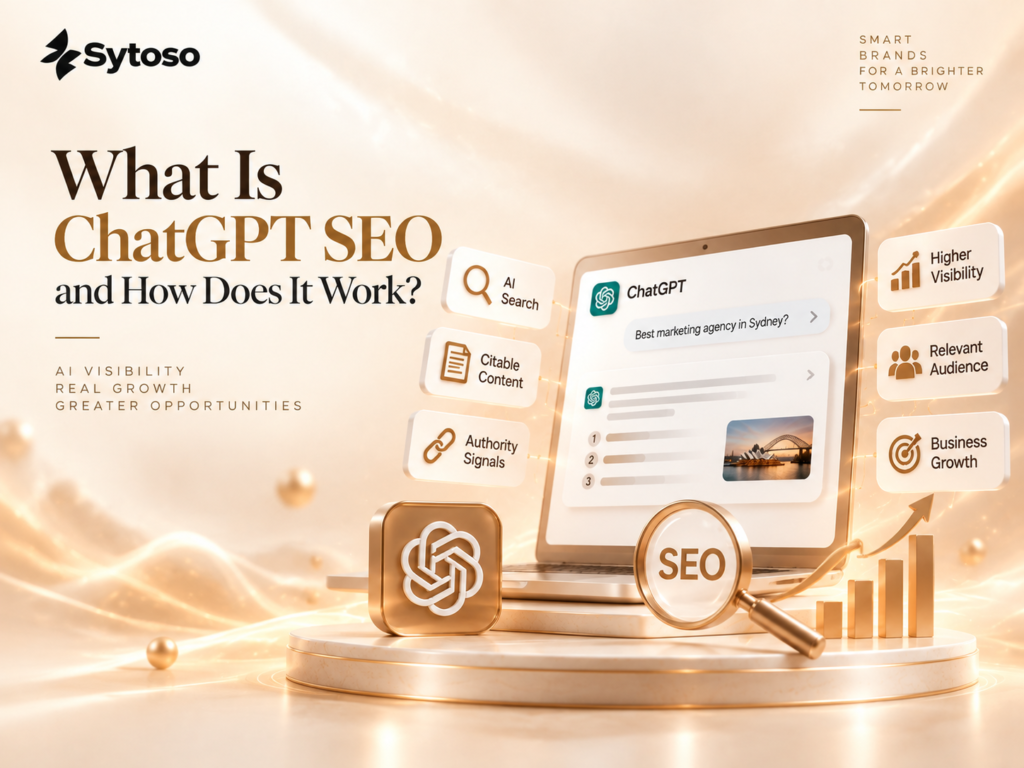
Search is no longer limited to a list of blue links. People now ask ChatGPT detailed questions such as “Which AI SEO agency is right for a law firm?” or “What is the best way to improve my company’s visibility in ChatGPT?”
ChatGPT SEO is the process of improving your website and wider online presence so your brand is more likely to be found, cited, mentioned, or recommended in relevant ChatGPT responses. It combines technical SEO, useful content, clear entity signals, authority building, and ongoing AI visibility monitoring.
For businesses that want to be discovered in AI-powered search, ChatGPT SEO services help turn scattered online information into clearer, more credible signals that AI systems can understand.
Jump to Section
- What Is ChatGPT SEO?
- How Does ChatGPT SEO Work?
- The Core Elements of ChatGPT SEO
- ChatGPT SEO vs Traditional SEO
- How to Improve Your Chances of Appearing in ChatGPT
- Conclusion
- FAQs about ChatGPT SEO
What Is ChatGPT SEO?
ChatGPT SEO has two meanings.
The first meaning is using ChatGPT as a tool to support traditional SEO work. For example, marketers may use it to group keywords, create content outlines, generate meta-description ideas, identify FAQs, or improve internal-linking suggestions.
The second and more important meaning is optimizing for ChatGPT itself. This means making your website, brand information, content, reviews, mentions, and authority signals easier for ChatGPT to retrieve and use when responding to users.
In simple terms, ChatGPT SEO is not about forcing an AI system to recommend your business. It is about making your business a clearer, more trustworthy, and more useful source for relevant questions.
It overlaps with AI SEO, LLM SEO, Answer Engine Optimization, and Generative Engine Optimization. However, ChatGPT SEO focuses specifically on improving visibility within ChatGPT search and answer experiences.
Why Does ChatGPT SEO Matter?
ChatGPT users often ask longer and more specific questions than people type into Google. Instead of searching for “AI SEO agency,” a user may ask:
- Which AI SEO agency helps SaaS businesses improve AI visibility?
- How can a local business appear in ChatGPT recommendations?
- What is the difference between ChatGPT SEO and traditional SEO?
These prompts include context, preferences, and commercial intent. A brand that appears in a relevant answer may gain visibility at an important stage of the buyer journey.
ChatGPT SEO can help businesses:
- Increase brand awareness in AI-driven search
- Earn citations and mentions in relevant answers
- Build trust before a visitor reaches the website
- Reach users with detailed, solution-focused questions
- Support visibility across other AI search platforms, including Perplexity, Gemini, and Google AI experiences
It should not replace traditional SEO. Strong Google and Bing visibility, helpful content, technical health, and relevant backlinks still provide an important foundation for AI search visibility.
How Does ChatGPT SEO Work?
When ChatGPT searches the web to answer a current or research-based question, it needs to identify relevant sources, interpret the information, and assemble a useful response.
The exact process is not fully public and can vary by query. Still, the core principle is straightforward: clear, relevant, accessible, and trusted information is easier for AI systems to use.
1. ChatGPT Needs to Find Your Website
Your website must be crawlable and indexable before it can become a useful source.
Important foundations include:
- A properly configured robots.txt file
- No accidental noindex tags on important pages
- XML sitemap submission
- Strong Google and Bing index coverage
- Fast, accessible pages
- Important content available as visible HTML text rather than only in images or difficult-to-render elements
Bing visibility is especially worth monitoring because it can support discovery in AI-powered web search experiences. Businesses should also use Google Search Console and Bing Webmaster Tools to identify crawl errors, indexing problems, and pages that are not being discovered.
2. It Looks for Relevant and Direct Information
AI systems need information that directly answers the user’s question.
For example, if a user asks, “How does ChatGPT SEO work?”, a strong page should clearly explain the process near the beginning. It should not make the reader scroll through several vague promotional paragraphs before finding an answer.
This is why answer-first content matters. Each key section should use a descriptive heading and begin with a direct explanation.
Useful formatting includes:
- Question-based headings where appropriate
- Short paragraphs focused on one idea
- Bullet lists for steps and comparisons
- Specific examples
- Clear definitions
- Original data, case studies, or expert commentary
The goal is not to write for robots. The goal is to make useful information easy for both people and AI systems to understand and quote accurately.
The Core Elements of ChatGPT SEO
Clear Brand and Entity Signals
An entity is the recognizable identity of a business. AI systems need to understand what your company is, what it offers, where it operates, and why it is relevant.
Your business name, services, industry, location, leadership details, website, social profiles, and directory listings should be accurate and consistent. Conflicting information across your website, LinkedIn profile, review platforms, and business directories can weaken trust.
Entity SEO strengthens those connections through consistent brand information, relevant structured data, authoritative mentions, and content that clearly explains your expertise.
Helpful, Original Content
Generic AI-written articles rarely create a strong reason for a brand to be cited. Businesses need content that adds genuine value.
This may include:
- Original research and statistics
- Detailed service or pricing guidance
- Expert-led explanations
- Real case studies
- Industry comparisons
- Practical checklists
- Clear answers to customer questions
For example, an accounting firm could publish a practical guide explaining when a small business should switch accounting software. A legal firm could explain common steps after a specific type of accident. This type of focused information gives AI systems useful material to reference.
Structured Data and Technical Clarity
Schema markup does not guarantee a ChatGPT citation. However, structured data can help search engines and AI systems better understand important page details.
Relevant schema may include:
- Organization schema
- LocalBusiness schema
- Service schema
- Article schema
- FAQPage schema
- Person schema
- Review and AggregateRating schema, where valid
Schema must match the visible content on the page. It should clarify existing information, not add unsupported claims.
Technical clarity also includes logical site architecture, clean internal linking, human-readable URLs, and important pages that are easy to reach from the main navigation or related content.
Authority and Third-Party Mentions
ChatGPT SEO is not only an on-site activity. A business may be mentioned or recommended because authoritative third-party sources discuss it.
Relevant signals may include:
- Quality backlinks
- Media coverage
- Industry publications
- Customer reviews
- Expert interviews
- Professional directories
- Partnerships
- Mentions in trusted niche resources
The focus should be on relevance and credibility, not simply collecting links. A relevant mention in a trusted publication can be more meaningful than several low-quality backlinks from unrelated sites.
ChatGPT SEO vs Traditional SEO
Traditional SEO aims to improve organic rankings, traffic, and conversions from search engines. ChatGPT SEO aims to improve a brand’s likelihood of being included in AI-generated answers.
| Traditional SEO | ChatGPT SEO |
| Focuses on rankings in search results | Focuses on citations, mentions, and recommendations |
| Targets keywords and search-result visibility | Targets conversational prompts and answer visibility |
| Measures rankings, traffic, and conversions | Measures citations, mentions, share of voice, and sentiment |
| Relies on technical SEO, content, and backlinks | Uses the same foundations plus entity consistency and AI visibility tracking |
The two strategies overlap. Good content, technical accessibility, topical authority, and relevant backlinks benefit both. The difference is that ChatGPT SEO also considers how a brand is represented across the broader web and whether its information is useful enough to be included in an answer.
How to Improve Your Chances of Appearing in ChatGPT
A practical ChatGPT SEO process usually includes these steps:
- Audit how ChatGPT currently describes your brand and competitors.
- Identify high-value customer prompts, including comparison, recommendation, and problem-solving questions.
- Fix indexability, crawlability, and technical content-access issues.
- Create direct, in-depth content around important topics and user intent.
- Strengthen entity consistency through schema, business profiles, and accurate brand details.
- Build relevant authority through quality mentions, reviews, citations, and digital PR.
- Monitor changes in brand mentions, citations, competitor visibility, and referral traffic.
This is an ongoing process. AI-generated answers can change as the web changes, new sources are published, and the user’s prompt becomes more specific.
Conclusion
ChatGPT SEO helps businesses become easier for AI systems to find, understand, trust, and reference. It combines strong technical SEO, clear entity signals, useful content, structured data, relevant third-party mentions, and ongoing AI visibility monitoring.
While no one can guarantee a citation or recommendation, a focused strategy can improve how your brand appears in ChatGPT and other AI search experiences. Sytoso – AI SEO Agency helps businesses build the clarity, authority, and AI-ready content needed for stronger visibility in modern search.
FAQs about ChatGPT SEO
What is ChatGPT SEO?
ChatGPT SEO is the practice of improving your website and online authority so ChatGPT is more likely to find, cite, mention, or recommend your brand in relevant answers.
Does ChatGPT SEO replace traditional SEO?
No. Traditional SEO remains important because strong indexing, useful content, backlinks, and technical health support AI search visibility too.
Can ChatGPT cite my website?
Yes, ChatGPT may cite websites when it uses web search. However, citations depend on the query, the relevance and authority of sources, and the information available.
How do you measure ChatGPT SEO?
Track relevant prompts over time and record brand mentions, citations, recommendation frequency, competitors shown, sentiment, and AI referral traffic.
Is ChatGPT SEO the same as GEO?
They overlap. ChatGPT SEO focuses on visibility in ChatGPT, while GEO is broader and covers optimization for multiple generative AI search platforms.